

How to Analyze Competitors Without Obsessing Over Them
Founders tend to handle competitors in one of two broken ways.
The first group ignores them. "We don't really have competition" — usually said with pride, usually wrong, and usually a sign that the founder has defined the market so narrowly that only their own product fits the definition.
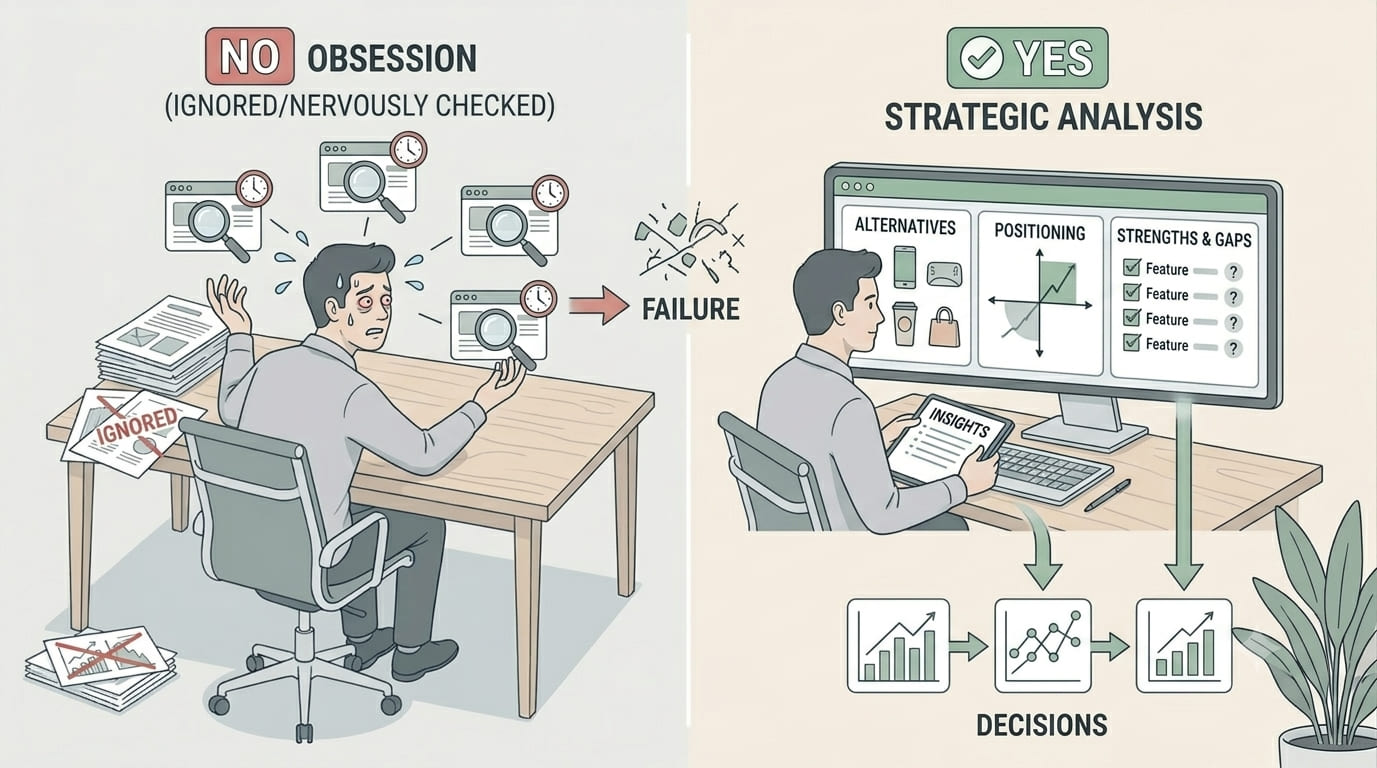
The second group can't stop looking. They check competitor changelogs like a nervous habit, feel a small spike of dread with every competitor launch post, and slowly let someone else's roadmap start writing theirs.
Both groups are failing at the same task. Competitor analysis exists to answer a small number of strategic questions — and then get out of the way.
This piece breaks down what competition actually includes, why obsessing over rivals hurts more than it helps, what's genuinely worth researching, where to find it, and how to turn what you learn into decisions instead of anxiety.
Competition Is Bigger Than Your Rival List
Start with the definition, because most competitor analysis fails before it begins — at the question of who counts.
Michael Porter made this point in his classic Harvard Business Review article on the five competitive forces: managers routinely define competition too narrowly, as if it only happened among today's direct rivals. In Porter's framework, the fight over value in an industry also runs through substitutes, potential new entrants, and the bargaining power of customers and suppliers — forces that don't show up on a "competitors" slide but shape what you can charge and how you can win.
For an early-stage product, the substitute problem is the one that bites hardest. Your real competition is whatever your target customer would do without you — and for most new products, that is not a rival tool. It is a spreadsheet. A freelancer. A pile of ChatGPT prompts. Or the most common competitor of all: doing nothing and living with the problem.
This reframing changes the analysis completely. A founder who only studies the two most similar SaaS products misses the fact that 80% of their prospects currently "solve" the problem with a Google Doc — which means the pitch that matters is not "better than Competitor X" but "better than what you're doing right now."
So the first output of a good competitor analysis is a complete list of alternatives, in three groups: direct competitors (similar product, same customer), indirect competitors (different product, same job), and non-consumption (the customer does it manually, or not at all). If your list only contains the first group, the analysis is already too narrow.
Why Obsession Is Worse Than Ignorance
Between the two failure modes, obsession does more damage — because it feels like diligence while quietly steering the company.
Y Combinator is blunt about this in its essential startup advice: spending time worrying about competitors is nearly always a bad idea in the first year or two, captured in the line that startups die of suicide, not murder. Competitive dynamics eventually matter enormously. Early on, the thing most likely to kill you is your own product not being wanted — not a rival's feature release.
The failure data points the same direction. CB Insights' analysis of startup failure reasons does list being outcompeted among the common causes — but well below lack of market need. Far more startups build something nobody wants than get beaten by a rival at something people do want.
Obsession also produces specific, predictable damage:
Feature-parity roadmaps. Every competitor launch becomes a to-do item. The product grows sideways, copying whatever anyone else shipped, and loses the sharp focus that was its only real advantage.
Reactive positioning. Messaging starts defining the product by comparison — "like X, but cheaper" — which hands the competitor the frame and you the leftovers.
Emotional whiplash. A competitor's funding announcement or launch post says almost nothing about your business. Their marketing is their highlight reel; you're comparing it to your backstage. Making strategy from that comparison is making strategy from noise.
The fix is not to look away. It's to look at the right things, on a schedule, for a purpose.
What's Actually Worth Analyzing
The useful questions about a competitor are strategic, not cosmetic. For each serious alternative on your list, you want to understand five things.
Who exactly do they serve?
Not the market — the customer. Which segment, at which stage, at which company size? Two products with near-identical features often serve meaningfully different customers, and that difference is where your space lives. Their homepage language, case studies, and pricing tiers tell you who they're built for.
What promise are they making?
Read their positioning as a claim: what outcome, for whom, against what alternative? Write it down in one sentence per competitor. When you later work on your own positioning, this map is what lets you find the space competitors have left open instead of shouting the same promise louder.
How do they charge?
Pricing model, tiers, and what the price scales with. This reveals their strategy more honestly than any About page: who they consider their best customer, where they expect expansion revenue, and which customers they're happy to lose.
Where are they weak — according to their own customers?
This is the highest-value research in the entire exercise, and it's public. Reviews on G2, Capterra, and app stores; Reddit threads; community complaints. Ignore the star averages and read the 2-, 3-, and 4-star reviews, where customers describe what they wanted and didn't get. You are reading, verbatim, the unmet needs of people who already pay for a solution to the problem you solve. There is no cheaper market research anywhere.
How do they reach customers?
Which channels visibly work for them — SEO, communities, partnerships, outbound? You're not doing this to copy the playbook. You're doing it to understand where attention in this market already flows, which feeds directly into understanding your market as a whole.
Notice what's missing from this list: an exhaustive feature comparison. Feature tables have exactly one honest use — sales conversations where a prospect asks — and one dishonest one: convincing yourself you're ahead or behind. Features change monthly. The five things above change slowly, and strategy should rest on the slow-moving parts.
Where to Look
All of this is findable without tools, subscriptions, or anything resembling espionage.
Their website, read like an analyst. Homepage for positioning, pricing page for strategy, case studies for target customer, careers page for direction — a company hiring three salespeople and a compliance manager is telling you where it's headed.
Review platforms. As above: the middle-star reviews are the gold. Take actual quotes into your notes, not summaries — the customer's own words are the asset.
Communities where your customers gather. Search the competitor's name in relevant subreddits, Discords, and forums. Unfiltered comparisons, migration stories, and "is X worth it?" threads are how buyers actually talk when nobody is selling to them.
Your own customer conversations. The single best question in any customer interview: "What did you use before, and why did you switch?" Every answer is a competitor analysis conducted by someone with real stakes.
Changelogs and launch posts — quarterly, not daily. A quick pass every few months shows you the direction of travel. Checking weekly shows you the same thing, plus anxiety.
Turn It Into Decisions, Then Put It Away
Research that doesn't end in a decision is a hobby. Close each analysis round by answering four questions in writing:
Where is the open space? Given the promises everyone else is making, which customer or which job is underserved? That gap is positioning raw material — the input for your USP, your messaging, and your comparison pages.
What will we deliberately not match? Choose the competitor strengths you will concede. A focused product beats a defensive one, and conceding on purpose is what focus looks like from the outside.
What did their customers teach us? Turn the review-mining into two or three concrete product or messaging insights — needs that are real, expressed, and unmet.
What would actually change our strategy? Define in advance the one or two competitor moves that would genuinely matter — entering your exact niche, collapsing prices, closing your core differentiator. Those are your tripwires. Everything else that happens between now and the next quarterly review is, by prior agreement with yourself, noise.
Then — and this is the discipline most founders skip — put it away. Date the document, calendar the next review for a quarter out, and go back to the work that determines whether you survive: talking to your customers and building what they need.
Competitors are weather. You check the forecast before you plan the week; you don't stand at the window all day. The businesses that win crowded markets almost never win by watching the crowd. They win by knowing one customer better than anyone else watching them.
If you're mapping your market and working out where your business fits against the alternatives, VynaroAI's research and positioning tools can help you turn scattered competitor notes into a clear picture. Start at VynaroAI.