

How to Find Customer Pain Points Worth Building On
Ask people about their problems and you will get a long list. Ask them what they have actually done about those problems and the list gets very short, very fast.
That gap is where most early ideas quietly die. Founders collect complaints, treat them as pain points, and build solutions for problems that people are perfectly willing to live with. The complaint was real. The pain was not.
This piece breaks down the difference between a complaint and a pain point, where real pain tends to hide, and how to decide whether a pain point is strong enough to build on.
A Complaint Is Not a Pain Point
People complain about almost everything. Software is too slow. Meetings are too long. Pricing is confusing. Most of these complaints cost nothing to say and change nothing about how the person behaves afterward.
A pain point is different. A pain point has consequences you can observe.
Someone is losing hours every week to a manual process. Someone is paying for two overlapping tools because neither fully solves the problem. Someone built a fragile spreadsheet system that only they understand, and they are afraid to touch it. Someone missed revenue, lost a client, or shipped late because of the problem.
The distinction matters because people will agree that almost any problem is annoying. They will only spend money on problems that are costing them something they care about — time, revenue, reputation, or peace of mind.
So the first filter is simple. When someone describes a problem, look for the consequence. If there is no consequence, you are probably looking at a complaint.
Look for the Job Behind the Problem
A useful shift is to stop asking "what problems do people have?" and start asking "what are people trying to get done, and where does it break down?"
This is the core of the jobs-to-be-done perspective described by Clayton Christensen and his co-authors in Harvard Business Review: customers essentially hire products to get a job done, and the most interesting opportunities sit around jobs that are currently done badly. One of their examples involves condo developers who struggled to sell to retirees until they realized the real job was not buying a smaller home — it was managing the difficult transition out of a life's worth of belongings. Once they supported that job, sales moved.
For a founder hunting pain points, the lesson is practical. The pain is rarely the surface-level task. It sits in the friction around the job: the preparation nobody enjoys, the handoffs that go wrong, the decisions people feel unqualified to make, the emotional weight of getting it wrong.
When you map the full job — before, during, and after — the pain points stop being abstract and start having locations.
Where Real Pain Hides
You do not usually find strong pain points by asking "what's your biggest problem?" People give rehearsed answers to that question. You find pain in behavior.
Workarounds. When someone duct-tapes three tools together, exports data into a spreadsheet, or maintains a personal checklist to survive a process, they have already told you the problem is real. Nobody builds a workaround for a problem they do not feel.
Money already being spent. If people pay for a mediocre solution, hire freelancers to handle a task, or buy courses to learn their way around a problem, the willingness to pay is proven. Your question is no longer "would anyone pay?" but "why would they switch?"
Repeated time loss. A problem that costs four hours once a year is rarely worth building on. A problem that costs forty minutes every single day is a different category, even if it sounds smaller.
Emotional language. Listen for words like "I hate," "I dread," "I always mess this up," or "I avoid it until I can't anymore." Frustration that people volunteer without being prompted is usually attached to something real.
Public complaints. Reddit threads, review sections of competing products, community forums, support discussions. People are more honest in places where they are not talking to you. One-star and three-star reviews of existing tools are especially useful, because they describe pain inside a market that already spends money.
Talking to People Without Leading Them
Conversations are still the richest source of pain points — if you run them properly.
The failure mode is well documented. Nielsen Norman Group's guidance on user interviews makes the point that interviews are strong for understanding experiences and needs, and weak for predicting future behavior. Asking "would this help you?" produces polite speculation. Asking "tell me about the last time this happened" produces evidence.
The Mom Test pushes the same discipline further: talk about the person's life and past behavior, not your idea. The moment you pitch, people start protecting your feelings.
In practice, a pain-point conversation needs surprisingly few questions:
- Walk me through the last time you dealt with this. What exactly did you do?
- What have you already tried? What happened?
- What does it cost you when this goes wrong?
- If nothing changes, what happens?
- Have you ever paid for anything, or paid someone, to make this easier?
Notice that none of these questions mention your solution. That is deliberate. You are trying to find out how the problem behaves in the wild, not how your idea performs in a friendly demo.
Specific stories beat general opinions every time. "It's frustrating" tells you little. "Last Tuesday I spent three hours reconciling this by hand and still sent the wrong version to a client" tells you almost everything.
Ranking Pain Points: Not All Pain Is Equal
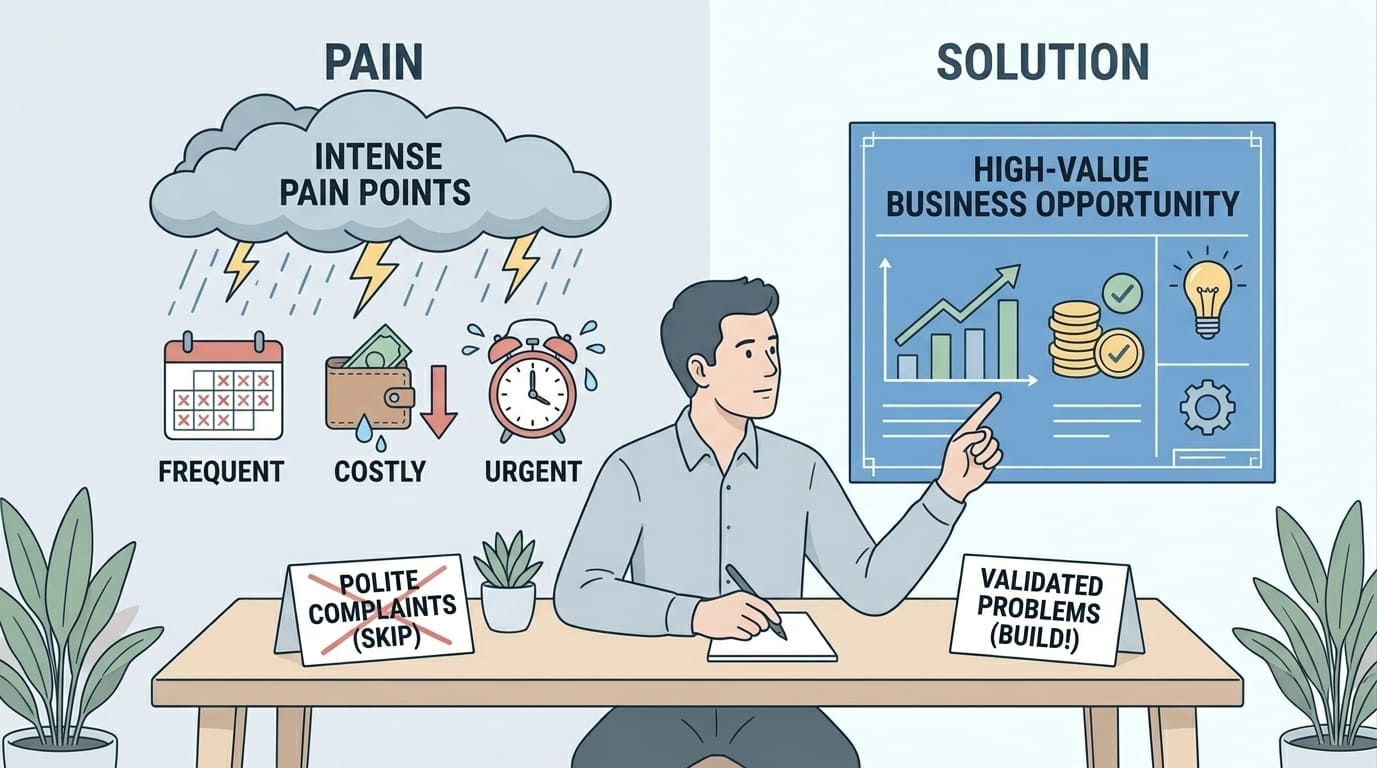
Once you have a list of real pain points, you need a way to compare them. Three questions do most of the work.
How often does it happen?
Frequency compounds. Daily and weekly pain builds urgency and makes people actively search for solutions. Rare pain, even severe pain, is harder to build a business on because the buying moment almost never arrives.
How much does it cost when it happens?
Cost can be money, time, risk, or stress. The strongest pain points combine a measurable cost with an emotional one — the founder who loses a weekend to bookkeeping and feels incompetent doing it is feeling both.
Who feels it most?
A pain point that is mild for most people and severe for a specific group is often more valuable than one that is moderate for everyone. The severe group gives you a clear first customer, sharper messaging, and honest early feedback. Broad, shallow pain produces broad, shallow interest.
A pain point that scores high on all three — frequent, costly, concentrated in an identifiable group — is worth serious attention. A pain point that scores high on only one is worth watching, not building on yet.
Signals That a Pain Point Is Not Worth Building On
It helps to know the negative signals too, because some pain points look attractive and lead nowhere.
People acknowledge the problem but have never attempted any solution — no workaround, no search, no spending. The pain is real but tolerable, and tolerable pain does not convert.
The pain only exists during a rare event, and the person forgets about it the rest of the year.
Solving it depends on changing an ingrained habit rather than replacing a hated task. Removing friction is a business. Reforming behavior is a crusade.
Only you seem to feel it strongly. Founders regularly project their own frustrations onto a market. Sometimes that instinct is right, but it has to survive contact with strangers before it counts as evidence.
From Pain Point to Decision
Finding a strong pain point is not the end of validation — it is the entry ticket. The pain still has to connect to a customer you can reach, a solution you can realistically build, and a price that makes sense against the cost of the problem.
But the order matters. Founders who start from the solution spend months looking for a problem that fits it. Founders who start from a verified pain point already know why anyone would care.
If you take one thing from this piece, take the consequence test. When someone tells you about a problem, do not write down the problem. Write down what it has already cost them and what they have already done about it. If both answers are "nothing," keep looking.
The best ideas rarely come from a flash of inspiration. They come from watching people struggle with something specific, again and again, and taking that struggle seriously.
If you're working through which problem is actually worth solving, VynaroAI's structured tools can help you examine pain points, customer segments, and validation signals in one place. Start free at VynaroAI.