

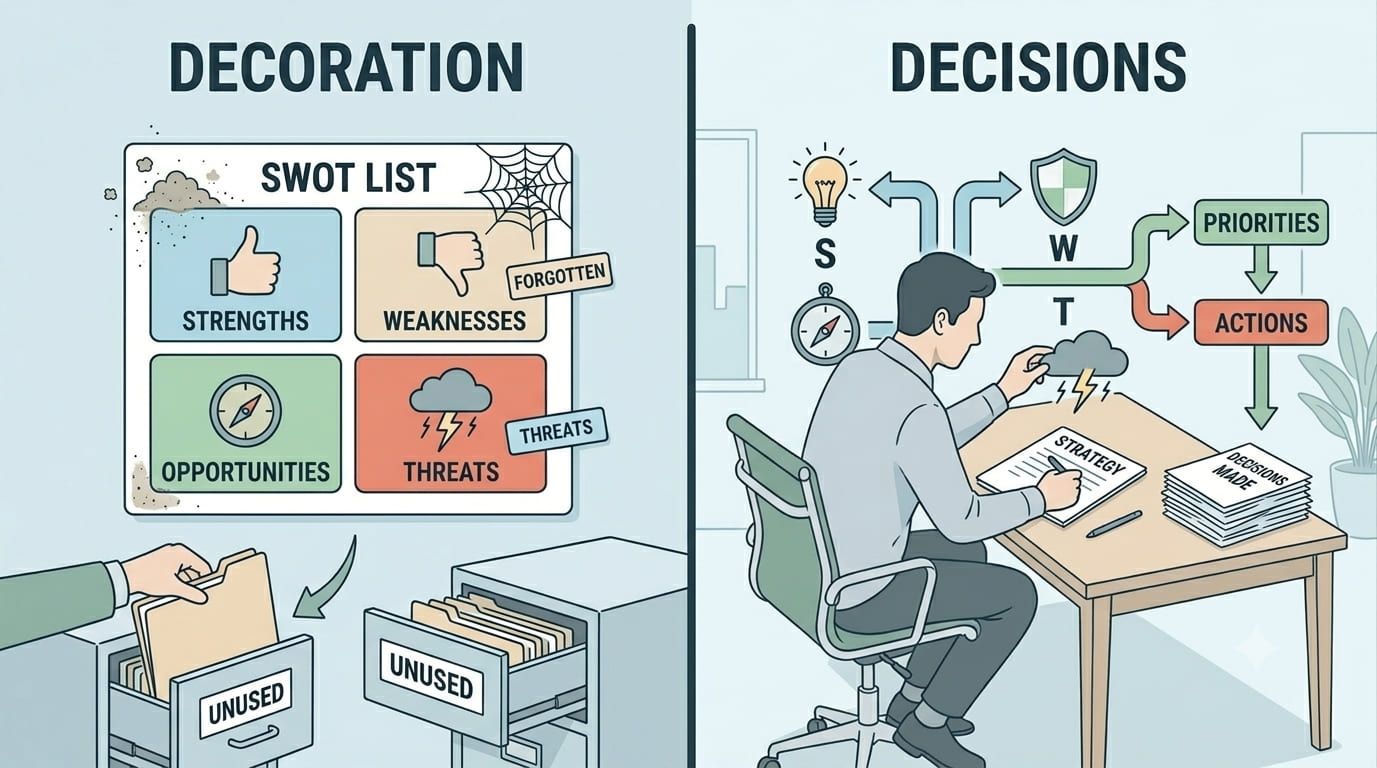
How to Run a SWOT Analysis That Actually Changes What You Do
SWOT has a strange reputation. It is one of the most widely used strategy tools in existence, and one of the most quietly useless in practice.
The framework itself is old. Researchers who traced the origins of SWOT analysis in the journal Long Range Planning followed it back to planning research at the Stanford Research Institute in the 1960s — work funded by large corporations trying to understand why their planning kept failing. The irony is that decades later, SWOT itself became a planning ritual that often fails in exactly the way it was meant to prevent.
The evidence for that is unusually concrete. In a well-known study, also published in Long Range Planning, Hill and Westbrook reviewed how companies actually used SWOT with their consultants. The pattern across the applications they examined was consistent: long lists — averaging more than 40 factors — vague and general descriptions, no prioritization, no attempt to verify any of the points. And the most damning finding of all: the outputs were essentially never used in the later stages of the strategy work. The authors titled the paper "SWOT Analysis: It's Time for a Product Recall."
So why write about SWOT at all? Because the failure is in the usage, not the structure. Used lazily, SWOT produces decoration. Used with discipline, it is one of the fastest ways for a solo founder to see their situation honestly.
This piece breaks down where SWOT goes wrong, what each quadrant actually means for an early-stage business, and a process that ends in decisions instead of a forgotten four-box diagram.
Why SWOT Fails in Practice
Three habits kill most SWOT analyses, and they are the same habits Hill and Westbrook documented decades ago.
Everything gets listed, nothing gets weighed. Twelve strengths and fourteen weaknesses, all typed with equal font size and equal seriousness. But a list where everything matters is a list where nothing does. Strategy is prioritization, and a SWOT without priorities is an inventory.
The entries are compliments and worries, not facts. "Strong founding team." "Innovative product." "Competition." These phrases feel like analysis and carry no information. Nobody has ever changed a decision because a slide said "innovative product."
Nothing happens afterward. The analysis is completed, admired, and filed. No entry is connected to an action, a test, or a decision. This is the finding that should sting the most: in the study above, the single biggest problem was not bad content but abandoned output.
If you recognize your own past SWOT attempts in this list, the fix is not a better template. It is a stricter process.
What the Four Quadrants Mean for an Early-Stage Founder
The classic definitions — internal versus external, helpful versus harmful — are correct and not very actionable. For a founder pre-launch or just past it, the quadrants are more useful when framed as questions.
Strengths: what do you have that is real and hard to copy?
Not virtues. Assets. Specific domain knowledge from your previous work. An audience you've built. Unusually low personal burn that lets you survive longer than funded competitors. Speed, because you have no organization to coordinate. A distribution channel you understand deeply.
The test for a real strength: could you use it in a sentence that starts with "Because of this, we can…"? "Strong team" fails that test. "I've spent six years inside the industry I'm selling to, so I can write to customer pain in their exact language" passes it.
Weaknesses: what is true about you that you'd rather not write down?
This quadrant only works with uncomfortable honesty. No technical co-founder. No audience. No revenue. A product that depends on a single API provider. One founder, which means one person's health and motivation is a structural risk.
Weaknesses are not confessions and they don't all need fixing. They need to be known, because strategy is partly the art of routing around what you lack.
Opportunities: what is changing outside that works in your favor?
Opportunities live outside your company — in shifts of behavior, technology, regulation, or competitor neglect. A competitor raising prices and irritating its base. A new platform hungry for content in your niche. A category of customer that established players consider too small to serve.
The common mistake here is listing your own plans ("launch a mobile app") as opportunities. Plans are decisions. Opportunities are conditions.
Threats: what could hurt you that you don't control?
Platform dependency. A well-funded competitor moving into your niche. Regulatory change in how your product category operates. Price pressure from tools bundling your feature for free.
Threats are the quadrant founders most like to skip, which is exactly why writing them down has value. A threat you have named is a threat you can watch, hedge, or design around. A threat you've avoided thinking about arrives on its own schedule.
A Process That Ends in Decisions
Here is a way to run SWOT that takes an evening and produces output you will actually use.
Step 1: Collect with evidence
Write your entries, but attach evidence to each one. "Weakness: no distribution — zero email subscribers, no social following in the target market." If an entry has no evidence, either find some or mark it as an assumption. This single rule eliminates most of the vague filler that made the studied SWOTs useless.
Step 2: Cut each quadrant to three
Force-rank and keep the top three per quadrant. Twelve entries total, maximum. The cutting is the analysis — deciding that your lack of audience matters more than your lack of a co-founder is a strategic judgment, and the discomfort of making it is the work.
Step 3: Cross the quadrants
This is where SWOT stops being a list and starts being strategy. Ask four combination questions:
- Which strength can I aim at which opportunity? (This usually becomes your main offensive move.)
- Which strength can neutralize which threat?
- Which weakness blocks which opportunity — and is it worth fixing for that reason?
- Where does a weakness meet a threat? (This intersection is your real risk. It deserves a plan, even a rough one.)
A solo founder might find, for example, that deep niche expertise (strength) matched with an underserved customer segment (opportunity) defines the wedge — while single-founder fragility (weakness) crossed with a fast-moving competitor (threat) argues for keeping scope brutally small until revenue arrives.
Step 4: Translate into three commitments
End the session with exactly three written commitments: one thing you will start, one thing you will stop or avoid, one risk you will actively monitor with a defined trigger ("if X happens, I do Y"). Put them where you plan your weeks.
This step is the entire difference between analysis and decoration. It is the direct answer to the finding that SWOT outputs are never used: you build the usage into the exercise itself.
Step 5: Date it and repeat it
A SWOT is a snapshot, and early-stage situations change fast. Write the date on it and redo it when something material shifts — a launch, a new competitor, a pricing change. Comparing snapshots over time is quietly one of the most useful things the tool offers: you get to see which worries were real and which strengths actually got used.
Keep the Tool in Its Place
SWOT will not tell you whether your idea is good, what your customers want, or how big your market is. It has no data of its own; it only organizes what you already know and forces you to look at it in one frame. That is a modest job, done well.
The version worth doing is small, evidenced, ruthlessly prioritized, and finished with commitments. The version worth skipping is the forty-item wall of adjectives that has been failing companies since the nineties.
One evening, twelve honest entries, three decisions. If your SWOT produces less honesty or fewer decisions than that, the framework is not the problem.
If you want to work through your strengths, weaknesses, opportunities, and threats with structure instead of a blank page, VynaroAI's SWOT tool connects the analysis to the rest of your business context. Start at VynaroAI.