

Why Most Founders Validate Wrong — And What Actually Works
You talked to people. You got positive reactions. Everyone said it sounded like a great idea.
Then you built it. And nobody showed up.
This isn't a rare story. It's one of the most common ones in early-stage building. And the problem isn't that founders skip validation — most don't. The problem is that the validation they do feels real but isn't. It gives them confidence, but not evidence.
Older CB Insights startup failure research famously identified lack of market need as one of the most common reasons startups fail. The lesson still matters: many founders don't fail because they skipped validation entirely. They fail because they collected opinions instead of evidence.
This piece breaks down where validation goes wrong, what actually works, and how to know when you have a signal worth building on.
The Illusion of Validation
Here's what bad validation looks like in practice.
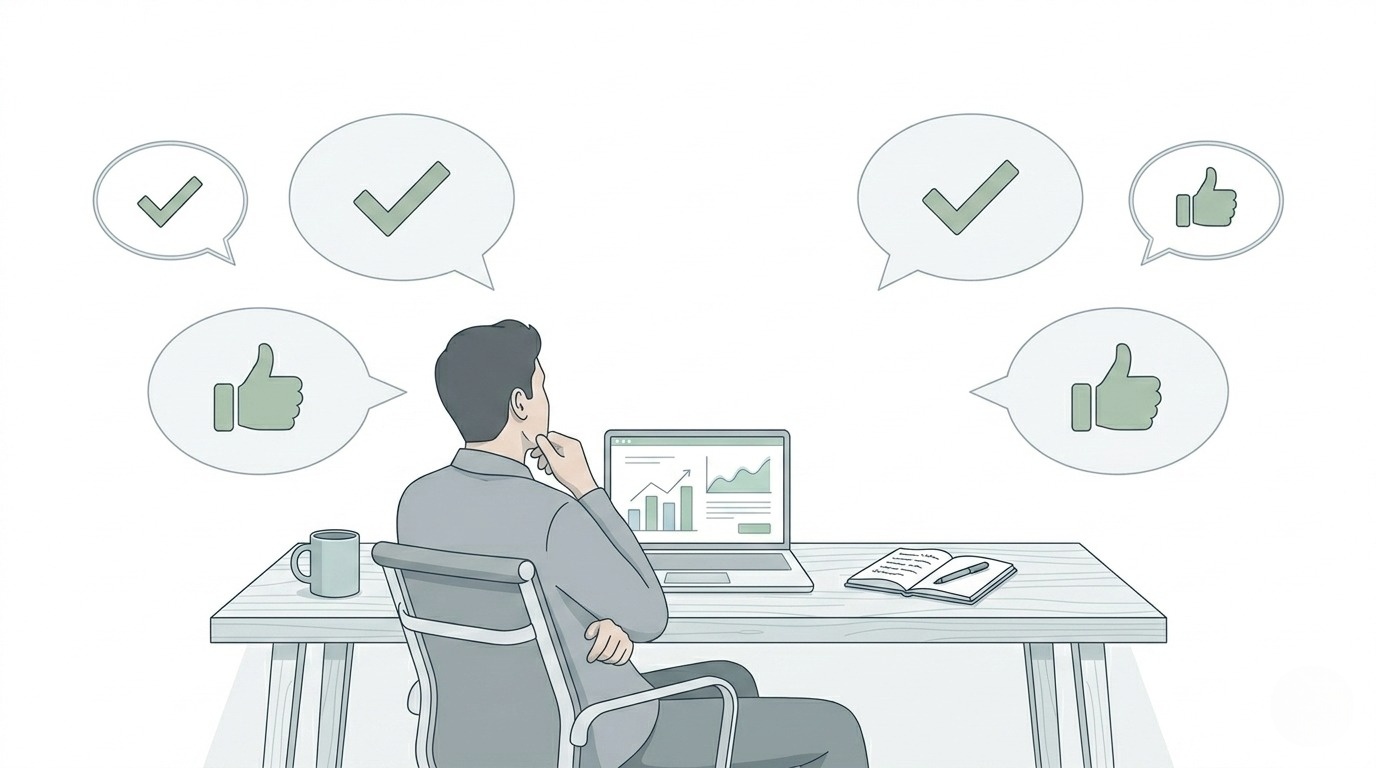
You explain your idea to someone. They nod. They say "that's interesting" or "I'd definitely use that." You walk away feeling like you've confirmed something. You repeat this ten times and the pattern holds. So you build.
The problem is that agreement is frictionless. It costs the other person nothing to say yes. They're not committing money. They're not committing time. They're just being polite — or genuinely optimistic on your behalf — without any real skin in the game.
What you've actually tested is how well you can explain an idea. Not whether anyone needs it enough to pay for it.
This is a form of confirmation bias in validation. You subconsciously steer conversations toward positive reactions. You frame questions in ways that invite agreement. And because the people you talk to — friends, family, colleagues — want to support you, they give you what you're looking for.
The result is a false positive. You feel validated. You're not.
The Question That Changes Everything
Most founders ask the wrong question.
They ask: "Would you use this?"
The right question is: "What are you doing right now to solve this problem?"
The first question invites imagination. People can easily picture themselves using something that doesn't exist yet — especially if you describe it well. The second question requires reality. It forces the person to describe actual behavior, actual workarounds, actual frustration. This is the core idea behind The Mom Test: ask about real behavior, not hypothetical intent.
If they're stitching together three different tools to solve a problem, that's a signal. If they're spending hours doing something manually that should take minutes, that's a signal. If they shrug and say they haven't really thought about it — that's also a signal. Just not the one you want.
Behavior tends to be honest. Opinions tend to be optimistic.
What Real Validation Looks Like
Real validation isn't a single conversation or a survey. It's a pattern of honest signals across multiple methods — and the willingness to hear what you don't want to hear.
Talk to strangers, not friends.
Friends want you to succeed. They will round up. Talk to people who have no reason to be kind to you — people who actually face the problem you're trying to solve and have no relationship with you. Their reactions are usually less biased. Y Combinator's guidance on talking to users covers this well.
Look for existing behavior, not hypothetical intent.
Find where people are already spending money or time trying to solve the problem. If they're paying for an imperfect solution, that's a strong sign the problem is real. If nobody is doing anything about it, ask yourself why.
Test willingness to pay early.
This is the clearest signal of all. A pre-order, a deposit, a paid pilot, a serious demo request, or a waitlist signup with clear intent — these filter out polite interest quickly.
Look at where people complain.
Reddit threads, product reviews, forums, social media comments — these are places where people are honest because they're not talking to you. Find the specific language they use to describe their frustration. That language is more valuable than any survey result.
Test before you build.
A landing page with a clear value proposition and a signup or purchase button tells you more in two weeks than months of interviews. If you can't convert attention into interest, revenue will be even harder.
How to Know When You Have a Real Signal
One positive reaction is interesting. Three people independently showing the same behavior is a signal. Five is a pattern.
The goal isn't to prove your idea is good. It's to find out if it's wrong — and if it survives honest testing, that's when you build.
That same pattern shows up in failure data: lack of market need remains one of the clearest warnings founders ignore too late.
Validation is uncomfortable because it exposes reality. That discomfort is exactly the point.
Where Most Founders Get Stuck
Even founders who understand all of this often get stuck in two opposite traps.
The first is moving too fast — taking one or two positive signals as enough to start building. One person reacting well is not a pattern. It's a data point.
The second is moving too slow — using validation as a form of procrastination. Doing fifty more interviews when you already have a clear signal. Researching instead of testing. Preparing instead of asking.
Real validation has a pace. You gather honest signals, you look for patterns, and when the pattern is clear enough — you act.
The Structured Approach
Validation doesn't have to be complicated. But it does have to be honest.
Start with the problem, not the solution. Before you describe what you're building, understand whether the problem is real and whether people feel it enough to do something about it.
Talk to people who face the problem directly — not your network, not people who know you. Ask them what they currently do. Listen for frustration, workarounds, and money already being spent.
Test willingness to pay before you build anything. A landing page, a pre-order, a pilot — something that requires a real commitment, not just an opinion.
Look for consistent signals across multiple sources. If interviews, landing page data, and market research are all pointing in the same direction, you have a stronger case to build. If only one source is positive, keep testing.
And when validation fails — treat it as the win it is. You just saved months of building something nobody wanted.
The Real Job of Validation
Validation isn't about confirming that your idea is good. It's about finding out as fast as possible if it isn't.
The founders who get this right aren't the ones who are most confident in their ideas. They're the ones who are most willing to be wrong early — because they understand that being wrong early costs almost nothing, while being wrong late can cost far more.
If you're still in the question phase — asking whether your idea is worth pursuing — that's exactly where structured validation belongs. Not gut feeling. Not your friends' opinions. Not a survey that confirms what you already hoped was true.
Real signals, honest testing, and the discipline to act on what you find.
Validate the idea before you build the wrong thing. Start free with VynaroAI.