

How to Write a USP That Doesn't Sound Like Everyone Else's
Take the homepage of almost any early-stage product and cover the logo. Could the headline belong to a competitor?
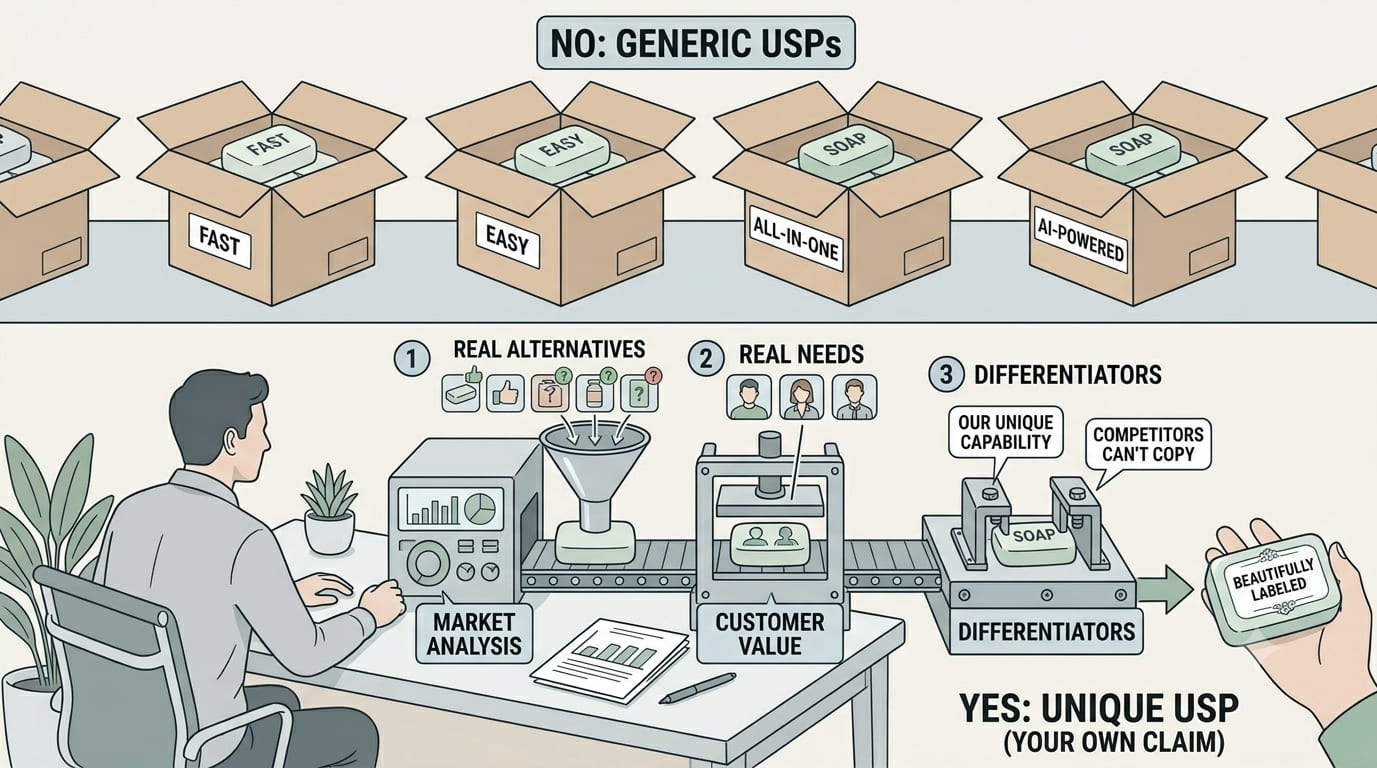
For most products, the honest answer is yes. "The fastest way to manage your projects." "All your work in one place." "AI-powered insights for growing teams." These sentences are grammatically unique and strategically identical. They could be swapped between ten companies without anyone noticing.
That is what a weak USP looks like in practice. Not wrong — just interchangeable.
This piece breaks down why generic USPs happen, what a strong one is actually made of, and a step-by-step process for writing one that only your business could credibly claim.
Why Most USPs End Up Generic
Generic USPs are rarely a writing problem. They are a decision problem.
A USP forces you to choose: this customer, not that one. This strength, not five strengths. This comparison, not a vague gesture at "other tools." Most founders avoid those choices because every choice excludes someone, and excluding people feels dangerous when you have few customers.
So they hedge. The USP becomes a summary of everything the product does, addressed to everyone who might use it. The result reads smoothly and says nothing.
There is also a knowledge problem underneath. You cannot write a differentiated USP without knowing what your customers currently compare you to, and many founders have never seriously examined that. They know their competitors' names. They do not know which alternatives — including spreadsheets, agencies, or simply doing nothing — their customers actually weigh.
The stakes are real. Strategyzer has pointed to research by the consultancy Simon-Kucher finding that 72% of new products and services fail to deliver on expectations. Products fail for many reasons, but a value proposition nobody can distinguish from the alternatives is a reliable contributor.
What a USP Actually Is
Strip away the marketing language and a USP is one clear answer to one question: why should this specific customer choose you over their realistic alternatives?
That definition contains three components, and every one of them has to be real.
A specific customer. Not "businesses." Not "teams of all sizes." A defined group with a shared situation — solo consultants drowning in admin, first-time founders preparing a pitch, small agencies juggling client reporting.
A meaningful difference. Something you do that the alternatives don't, or do noticeably worse. It can be a capability, a workflow, a business model, a depth of focus. What it cannot be is a quality claim everyone makes, like "easy to use" or "powerful."
A connection to value. The difference has to matter to that customer. A unique feature nobody cares about is trivia, not positioning.
April Dunford, whose book Obviously Awesome is one of the most practical treatments of positioning available, structures the whole exercise in this order: start from the competitive alternatives, identify what you have that they don't, translate those capabilities into value, and then define which customers care most about that value. The sequence matters. Founders who start from "what makes us special" usually end up describing features. Founders who start from "what would our customer do without us" end up describing differences that are visible from the customer's side.
The Raw Material: Alternatives, Differences, Value
Before writing anything, collect three lists.
1. The real alternatives
Ask recent customers — or people in your target segment — one question: "If this didn't exist, what would you use instead?" The answers are often humbling. The alternative is frequently not a direct competitor. It is Excel, a Notion template, a freelancer, ChatGPT with some prompts, or living with the problem.
Your USP has to win against these actual alternatives, not against the competitor list in your head.
2. The honest differences
For each alternative, write down what you genuinely do better and what they genuinely do better. Both sides. If you cannot name what a spreadsheet does better than your product (free, familiar, infinitely flexible), you are not being honest enough for this exercise to work.
Then circle the differences that are hard to copy — things rooted in your focus, your model, your data, or your depth in one niche. "We also have feature X" is copyable in a quarter. "We are the only tool built specifically for X-type founders, and everything is designed around that stage" is a position.
3. The value, in the customer's words
For each circled difference, answer: so what? What does the customer get — in time, money, confidence, or reduced risk? A tool like the Value Proposition Canvas is useful here because it forces you to map your product's pain relievers and gain creators against the customer's actual jobs, pains, and gains rather than against your feature list.
If a difference doesn't translate into value the customer would recognize, drop it. It might be true. It is not a USP.
Writing the Sentence
With the raw material done, the writing is almost mechanical. A workable structure:
For [specific customer], [product] is the [category] that [key difference], so you can [value].
You will not ship that template word-for-word — it is scaffolding, not copy. But forcing your positioning through it exposes weaknesses instantly. If the customer slot says "everyone," you haven't chosen. If the difference slot says "easily" or "quickly," you haven't differentiated. If the value slot restates the difference, you haven't connected it to anything the customer feels.
A few practical rules for the final version:
Write it in language your customer already uses. If your interviews and community research gave you phrases like "I never know if my idea is actually good," those words belong in your messaging far more than "validate concepts efficiently."
Make one claim, not three. A USP with three benefits is a paragraph, not a position. Pick the difference that matters most to your best-fit customer and let the rest live elsewhere on the page.
Prefer concrete over impressive. "Turn scattered research into an investor-ready pitch" beats "supercharge your fundraising journey" in every context that matters.
Test Whether It Actually Works
A USP is a hypothesis until customers react to it. Three cheap tests:
The cover-the-logo test. Put your USP next to your top three alternatives' headlines. If yours could be theirs, revise.
The stranger test. Show the sentence to someone in your target segment who has never seen your product. Ask them two questions: "What do you think this is?" and "Who do you think it's for?" If their answers are vague or wrong, the sentence is not doing its job — no matter how much you like it.
The objection test. A real USP creates objections. "Only for early-stage founders? What about established businesses?" That reaction is a feature. If your USP generates no objections from anyone, it has no edges, and positioning without edges is invisible.
Expect to revise. Positioning tightens as you learn who your best customers actually are, and the USP should follow that learning rather than being carved in stone at launch.
The Uncomfortable Part Is the Point
Writing a strong USP feels risky because it is a public commitment to a choice. You are telling most of the market "this is not primarily for you" so that a specific group hears "this was built exactly for me."
That trade is the entire mechanism. The founders who refuse it get a message that offends no one and moves no one. The founders who accept it get something rarer: a sentence that a specific customer reads and immediately understands why the alternatives — including doing nothing — are the weaker choice.
If your current USP could be swapped onto a competitor's homepage without anyone noticing, you don't have a writing problem. You have a decision waiting to be made.
If you're working out what genuinely sets your business apart, VynaroAI's USP and positioning tools can help you work from real alternatives and customer value instead of guesswork. Start at VynaroAI.