

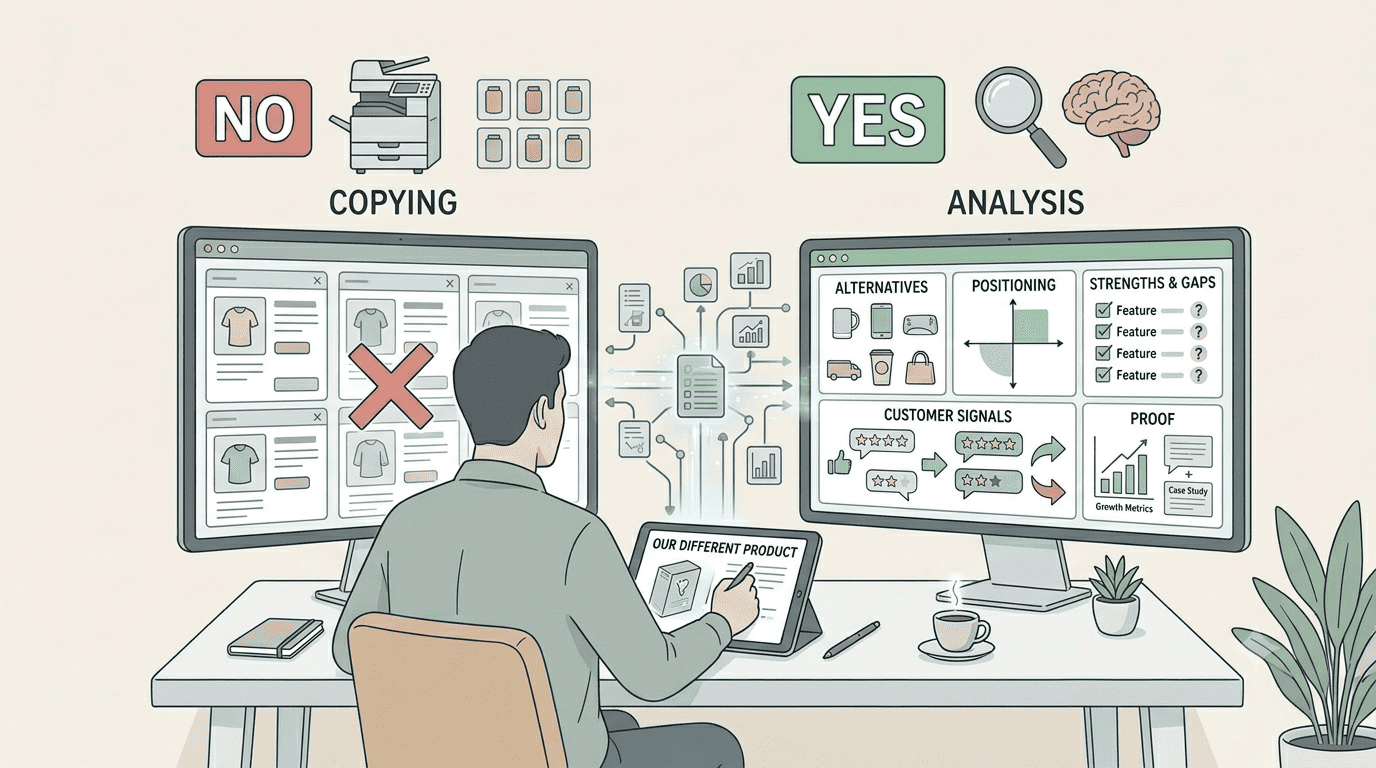
How to Analyze Competitors Without Copying Them
Competitor research can make a business sharper. It can also make it sound exactly like everyone else.
A founder opens five competitor websites. The same phrases appear again and again: save time, simplify workflows, grow faster, make better decisions, all-in-one, AI-powered, built for teams. After an hour of research, the market looks clearer but the founder's own message starts to blur.
The temptation is understandable. If competitors are visible, funded, or already trusted, their language feels safer. Their feature set feels like a checklist. Their pricing page feels like a benchmark. Their positioning feels like proof that this is how the market should be approached.
But copying competitors usually copies the surface, not the reasoning.
You see the headline. You do not see the customer research behind it. You see the feature list. You do not see which features drive retention. You see the pricing page. You do not see discounting, churn, sales conversations, or customer objections. You see what they chose to publish, not the full strategy.
Competitor analysis is not there to tell you who to become. It is there to help you understand the market clearly enough to make better choices.
This piece breaks down how to analyze competitors without copying them, so you can identify real alternatives, customer expectations, market gaps, proof, positioning patterns, and differentiation opportunities without turning your business into a weaker version of someone else's.
Competitor Analysis Should Start With the Customer
Many competitor reviews begin in the wrong place.
The founder starts with competitor websites, screenshots, feature tables, pricing pages, and social media profiles. That information is useful, but it can pull attention toward the competitor's story instead of the customer's decision.
A better starting point is the customer.
What problem are they trying to solve? What situation made the problem important? What are they using today? What do they already trust? What would make them switch? What would make them stay with the current workaround?
Those questions change the purpose of competitor analysis.
You are not only studying companies that look similar to yours. You are studying the options customers compare when they try to make progress.
That may include direct competitors, but it may also include spreadsheets, consultants, agencies, internal hires, templates, marketplaces, large platforms, manual workflows, or doing nothing for now.
If you only analyze companies in your product category, you may miss the real alternative.
A founder building software for client handovers might obsess over other handover tools. But the customer may actually compare the product with a project management platform they already use, a shared document, a kickoff meeting, or a senior operations person who keeps the process together manually.
The competitor list should come from the customer's world, not only from your category search.
Competition Is Broader Than Similar Products
Michael Porter's Five Forces framework is useful because it reminds businesses that competition is not limited to direct rivals. The Institute for Strategy and Competitiveness at Harvard Business School describes competitive forces such as substitutes, buyers, suppliers, new entrants, and rivalry among existing competitors.
For an early business, the most useful lesson is simple: customers have more options than your direct competitors.
A consultant competes with another consultant, but also with an internal hire, a course, a template, a founder doing the work alone, or postponing the project.
A software product competes with another tool, but also with a spreadsheet, a workflow inside an existing platform, a manual process, or the belief that the problem is not important enough yet.
A business research tool competes with other AI tools, but also with Google searches, Notion documents, investor templates, ChatGPT prompts, consultants, and the founder's own assumptions.
This matters because each alternative creates a different kind of value requirement.
If the alternative is a spreadsheet, the customer may care about structure, speed, and fewer mistakes.
If the alternative is an enterprise platform, they may care about focus, simplicity, and implementation effort.
If the alternative is hiring a person, they may care about cost, repeatability, and time to value.
If the alternative is doing nothing, the first job is not to prove you are better than a competitor. It is to prove the problem deserves attention at all.
Competitor analysis becomes more useful when it includes these hidden alternatives.
Do Not Copy the Market's Vocabulary Too Quickly
Competitor language is seductive because it feels validated.
If several companies use the same words, those words may seem like the correct market language. Sometimes they are. Customers may genuinely search for those terms or expect them in the category.
Other times, the repeated language is just a sign that everyone is avoiding specificity.
"Smarter workflows" may sound professional. It may also hide the real problem.
"AI-powered insights" may be accurate. It may still fail to explain what decision becomes easier.
"Built for growing teams" may describe the audience. It does not reveal which growing teams, in what situation, with which pain.
The goal is not to avoid common language entirely. Category language can help customers understand what kind of offer they are looking at. The risk is letting competitor vocabulary replace customer language.
Customer interviews, sales calls, reviews, support complaints, communities, and search queries often reveal sharper words than competitor websites do.
A competitor may say:
Streamline client operations.
A customer may say:
Every project starts with someone asking what was promised during sales.
The second sentence is less polished, but much more useful. It shows the actual moment where the problem appears.
When competitor language and customer language differ, do not automatically choose the more professional version. Choose the version that helps the right customer recognize the problem faster.
Study Positioning, Not Just Features
Feature comparison is the easiest part of competitor analysis. It is also the part most likely to become misleading.
A feature table can show what competitors claim to offer. It cannot tell you which features customers value most, which ones are rarely used, which ones are included only because buyers expect them, or which ones make the product harder to understand.
That does not mean feature research is useless. It means features should be read as clues.
Look at how competitors frame themselves.
- Are they positioned as simple, advanced, premium, affordable, specialized, all-in-one, self-service, expert-led, fast, safe, flexible, or built for a specific industry?
- Which customer do they seem to prioritize?
- Which pain do they lead with?
- Which proof do they show first?
- Which alternatives do they imply?
- What do they avoid talking about?
Positioning helps explain why a competitor's features are presented the way they are.
April Dunford's definition of positioning is useful here because it connects the offer, the customer, the value, and the context in which the product should be understood. Competitor analysis should therefore look beyond what competitors have built and examine how they want customers to compare them.
A competitor with fewer features may still win if its position is clearer.
A competitor with more features may still lose if customers cannot tell who it is really for.
The VynaroAI guide on positioning a business when competitors look similar goes deeper into how to turn this kind of comparison into a clearer market frame.
Look for Trade-Offs
Every competitor has trade-offs.
A tool that is highly configurable may require more setup. A service that is deeply customized may be slower or more expensive. A platform that covers many use cases may feel too broad for a narrow team. A simple product may be easier to adopt but less suitable for complex workflows.
These trade-offs are often more useful than generic strengths and weaknesses.
A weak competitor analysis says:
Competitor A has more features. Competitor B has better pricing. Competitor C has stronger branding.
A better analysis asks:
- What does this competitor choose to optimize for?
- What do they sacrifice because of that choice?
- Which customers benefit from that trade-off?
- Which customers may be poorly served by it?
- Where does our offer make a different trade-off?
This is where differentiation becomes more grounded.
You do not need to claim that competitors are bad. You need to understand where they are less suited to a particular customer, situation, constraint, or desired outcome.
For example, a large project management platform may be powerful. That does not make it the best fit for a small agency that only needs a reliable sales-to-delivery handover workflow. The opportunity is not "we have more features." The opportunity may be "we solve this narrower problem with less setup and fewer distractions."
A strong position often begins with a trade-off the business is willing to make.
Use SWOT Without Turning It Into a Template Exercise
SWOT analysis can be useful when it helps clarify decisions.
It becomes less useful when it turns into a generic list of strengths, weaknesses, opportunities, and threats that could apply to any company in the category.
The value comes from specificity.
A competitor's strength might be brand awareness in a narrow segment, a trusted integration, a strong partner channel, a clear niche, fast onboarding, or a pricing model that reduces purchase friction.
A weakness might be slow implementation, broad positioning, poor support reputation, weak proof for a specific customer group, excessive complexity, or a gap between the promise and customer reviews.
An opportunity might be an underserved segment, a clearer use case, a new buying trigger, a channel competitors have ignored, or a workflow that current tools treat as secondary.
A threat might be a larger competitor entering the niche, rising ad costs, a category becoming commoditized, changing customer expectations, or a substitute becoming good enough.
The question is not whether you can fill the four boxes. The question is what the boxes change.
If the SWOT does not influence your positioning, product priorities, market focus, pricing logic, sales message, or acquisition channel, it is probably too vague.
A useful SWOT should help answer:
- Where are competitors genuinely strong?
- Where are they weak only for a specific customer?
- Which market changes create room for a different approach?
- Which threats should shape our strategy now?
- What should we avoid copying because it does not fit our advantage?
Read Reviews for Friction, Not Just Complaints
Customer reviews can reveal what competitors' websites hide.
A website shows the intended promise. Reviews show where the promise meets reality.
Look for patterns in review sites, app marketplaces, communities, forums, Reddit threads, social media comments, YouTube comments, and customer case studies. Do not overreact to one angry review or one glowing testimonial. Look for repeated friction.
Useful review signals include:
- users praising a specific workflow or outcome
- repeated complaints about setup, support, pricing, complexity, reliability, or missing features
- customers describing why they switched
- customers mentioning which alternative they used before
- positive comments from one segment and negative comments from another
- language customers use when they explain the value in their own words
Reviews are not perfect research. They can be biased toward unusually happy or unhappy customers. Some categories have thin public review data. Larger brands may attract criticism simply because they have more users.
Still, reviews can show where customers feel the gap between marketing and experience.
That gap is often where better positioning, proof, onboarding, product focus, or customer selection can help.
Be Careful With Public Comparison Claims
Competitor analysis often becomes marketing.
That is where the standard should become higher.
It is one thing to use competitor research internally. It is another thing to publish comparison claims on a website, landing page, ad, or sales material.
If you say your product is faster, cheaper, easier, more accurate, more complete, or better suited to a customer type, the claim should be supportable. The FTC's small business advertising guidance explains that objective advertising claims should have proof before they run, especially when those claims are material to a customer's decision.
This is not only a legal issue. It is a trust issue.
Unclear comparison claims can make a business look insecure. Overstated claims can create sales friction. Negative competitor language can make the company sound less credible than the competitor it is trying to challenge.
A cleaner approach is to compare trade-offs.
Instead of:
We are better than Competitor X.
Say:
Larger platforms are useful when teams need broad project management. Our product is built for agencies that specifically need a structured handover from sales to delivery without adding a full implementation layer.
That kind of comparison is more useful because it helps the customer decide based on fit.
It also keeps the tone fair.
Turn Competitor Research Into Strategic Choices
The point of competitor analysis is not to collect information.
It is to make decisions.
After reviewing competitors and alternatives, the business should be able to answer:
- Which customer segment do we understand better than competitors?
- Which problem can we explain more clearly?
- Which alternative are we really replacing?
- Which trade-off are we willing to make?
- Which proof do we need because customers may doubt the claim?
- Which features matter because they support the position?
- Which features are distracting because they only copy the market?
- Which channels make sense based on how customers discover alternatives?
These answers should influence the business.
The homepage may need a clearer problem statement. The product may need to focus on one workflow instead of five. The sales process may need a stronger comparison against the current workaround. The pricing may need to reflect a narrower value. The content strategy may need to explain a problem competitors describe too broadly.
Competitor research that does not change any decision is often just market watching.
A clear analysis should help the business choose where to compete and where not to.
A Practical Competitor Analysis Process
You do not need a massive research project to analyze competitors well.
A focused process is usually enough.
1. Define the customer and use case
Start with the customer segment you are trying to understand.
For example:
Founder-led agencies with 5 to 20 employees that lose project context between sales and delivery.
That is much more useful than analyzing "agency software" in general.
The customer and use case decide which competitors matter.
If this step is unclear, the VynaroAI guide on defining your ideal customer profile can help narrow the segment before the competitor research becomes too broad.
2. List direct competitors, indirect alternatives, and doing nothing
Create three groups.
Direct competitors are companies solving a similar problem in a similar category.
Indirect alternatives are adjacent tools, services, people, or processes the customer may use instead.
Doing nothing is the current state the customer may keep if the pain is not strong enough.
This list prevents the analysis from becoming too category-focused.
3. Collect customer-facing evidence
Review competitor websites, pricing pages, demos, onboarding flows, ads, case studies, help docs, reviews, social posts, and public customer comments.
Focus on what customers can actually see and experience.
Do not assume that every public claim reflects what drives the business. Treat it as evidence, not truth.
4. Map positioning and trade-offs
For each competitor or alternative, note:
- Who do they appear to serve?
- What problem do they lead with?
- Which outcome do they promise?
- What proof do they show?
- What do they seem to optimize for?
- What do they sacrifice?
- Which customer would love this?
- Which customer might feel underserved?
This step turns scattered observations into strategy.
5. Compare customer language with competitor language
Look at how customers describe the problem in interviews, reviews, communities, and sales conversations.
Then compare that language with competitor messaging.
If competitors use abstract language but customers describe a concrete pain, you may have an opportunity to be clearer.
If customers use the same category words as competitors, you may need to use that language but add sharper context.
6. Identify your possible strategic response
Do not jump straight to a new headline.
Decide how the business should respond.
You may choose to focus on a narrower segment, emphasize a neglected workflow, build stronger proof, simplify the offer, avoid a feature race, change the market frame, or target an alternative competitors ignore.
The output should be a strategic choice, not just a list of observations.
Example: From Copying to Differentiating
Imagine a founder building a tool for small agencies that struggle with client project handovers.
The direct competitors include project management platforms, client portals, and agency operations tools. The indirect alternatives include kickoff meetings, shared documents, proposal notes, internal checklists, and senior team members who manually transfer context.
A shallow analysis might conclude:
Competitors have task management, file sharing, client communication, templates, dashboards, and integrations. We need those too.
That leads to copying.
A stronger analysis looks at the customer's actual problem.
Small agencies may not need another full platform. They may already have project management software. The repeated pain is that important information from sales does not reach delivery in a consistent format. The issue appears during the handover moment, not across the entire project lifecycle.
Now the position becomes clearer:
A structured sales-to-delivery handover workflow for small agencies that need every project to start with the right scope, expectations, risks, and commitments.
That does not copy the competitor. It chooses a narrower fight.
The product priorities also change. Instead of building a full project management system, the founder may focus on handover templates, required information fields, proposal-to-delivery context, risk flags, and a clear start-of-project summary.
The website changes too. It does not need to claim "all-in-one agency operations." It can speak directly to the moment where the customer feels the pain.
That is what good competitor analysis should do. It should make the business more specific, not more similar.
Common Mistakes in Competitor Analysis
The first mistake is copying features without knowing why they exist.
A competitor may have a feature because enterprise buyers expect it, because old customers requested it, because the product expanded beyond its original focus, or because it supports a different segment. Copying it may add complexity without improving your own position.
The second mistake is assuming the largest competitor defines the market.
Large companies often serve broad segments. An early business usually needs a narrower entry point. Competing on the same breadth can make the smaller company look incomplete.
The third mistake is treating pricing as a simple benchmark.
A competitor's public pricing does not show discounting, customer lifetime value, acquisition cost, sales effort, support load, or margin structure. Pricing research should inform your thinking, not replace your economics.
The fourth mistake is looking only at what competitors do well.
Weaknesses, gaps, confusing messages, poor-fit customers, review complaints, and underserved workflows may reveal more opportunity than the polished parts of a competitor's website.
The fifth mistake is becoming reactive.
Competitor analysis should not make the business change direction every time someone launches a feature, updates a homepage, or changes pricing. React when the evidence changes the customer's buying logic, not when a competitor makes noise.
Know What Not to Copy
Some parts of a competitor's business may be useful to study but wrong to copy.
- Do not copy a feature if it does not support your chosen customer and use case.
- Do not copy a category if it creates the wrong comparison.
- Do not copy a pricing model if your sales motion, cost structure, or customer value is different.
- Do not copy a content strategy if your audience, authority, and acquisition path are not the same.
- Do not copy a visual style if it makes your brand harder to recognize.
- Do not copy a promise if you cannot prove it.
The more you understand competitors, the more disciplined you need to become about what you ignore.
A business does not become differentiated by reacting to everything. It becomes differentiated by making consistent choices around a customer, problem, alternative, value, and proof.
Revisit Competitors When the Market Changes
Competitor analysis is not a one-time exercise.
It should be revisited when something meaningful changes.
A new competitor may define the category differently. A large platform may enter the niche. Customer reviews may reveal a growing frustration. Search behavior may shift. A substitute may become easier to use. Your own customer base may show that a different segment values the product more strongly.
Revisit competitor analysis when it can improve a decision.
Do not revisit it every week out of anxiety.
Too much competitor watching can make a founder reactive. The goal is not to know every move in the market. The goal is to understand enough to make better choices.
A useful rhythm might be a deeper review every few months, plus lighter monitoring for major changes. The right cadence depends on the speed of the market.
Competitor Analysis Should Make You More Yourself
Analyzing competitors is not about proving that your business is completely unique.
Most businesses are not unique in every way. They operate in markets with alternatives, expectations, habits, and existing language.
The work is to find the place where your business can be meaningfully different for a specific customer in a specific situation.
That difference may come from focus. It may come from a better workflow. It may come from stronger proof, clearer positioning, a better customer fit, a simpler buying path, or a trade-off competitors are not willing to make.
Competitor analysis is useful when it makes those choices clearer.
It becomes harmful when it turns the business into a collage of other companies' ideas.
Study competitors carefully. Understand what customers compare. Learn from the market's patterns. Notice the gaps. Respect what others do well.
Then decide what your business should become that theirs cannot or will not be.
For founders turning competitor research into clearer market, SWOT, USP, and positioning decisions, VynaroAI can help structure the work without turning competitor analysis into imitation.