

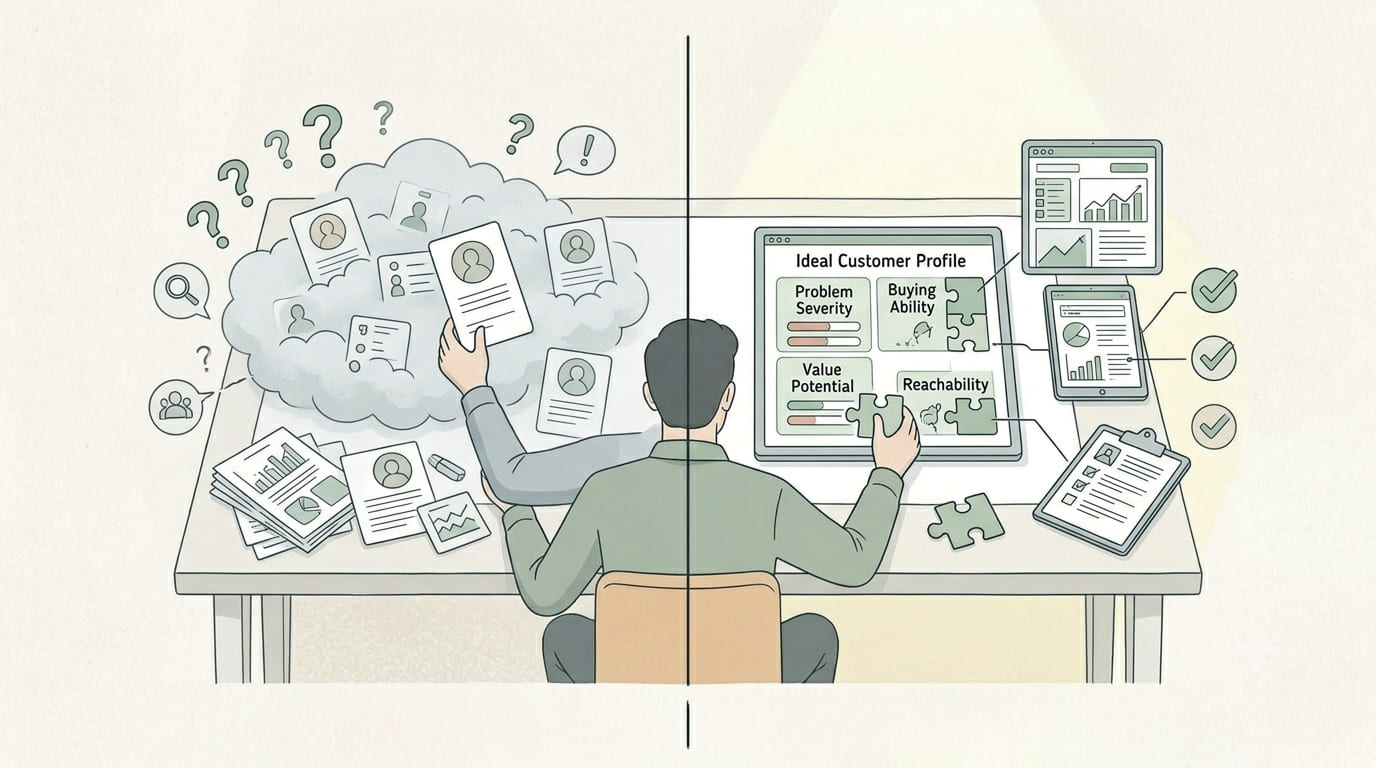
How to Define Your Ideal Customer Profile Without Guessing
A vague customer definition can make almost every business decision harder.
The product roadmap expands because too many different users ask for different things. The website stays broad because the business is trying not to exclude anyone. Marketing channels are chosen because they are popular, not because they match how the right customers actually buy.
Sales calls often make the problem obvious first. One prospect hears the offer as a productivity tool. Another thinks it is mainly for reporting. A third expects it to replace a process the product was never designed to handle. At some point, rewriting the explanation stops helping. The more useful question is whether these prospects are really the same kind of customer.
On paper, the target customer may already be defined: small businesses, founders, agencies, consultants, ecommerce brands, local service providers, or growing teams. Those labels can be useful at the beginning. They are rarely specific enough to guide serious decisions.
A useful ideal customer profile goes further. It describes the type of customer most likely to feel the problem, understand the value, pay for the solution, succeed with it, and remain worth serving.
This piece breaks down how to define an ideal customer profile without relying on guesswork, how to separate ICP from target audience and buyer persona, and how to turn customer evidence into a profile that improves research, positioning, messaging, and acquisition.
What an Ideal Customer Profile Actually Means
An ideal customer profile, often shortened to ICP, is a description of the customer type that is the strongest fit for your offer.
In B2B, this is usually a company or organization type: industry, size, business model, operating situation, buying process, and problem context. In B2C, it may describe a consumer segment with a specific need, situation, behavior, and willingness to pay.
Salesforce describes an ideal customer profile as the type of company that would be an ideal fit for a product or service, while a buyer persona describes the people involved in the buying process. That distinction is useful. But for an early or small business, "ideal" should not mean revenue alone.
A customer can pay and still be a poor fit.
They may require too much support. They may misunderstand the offer. They may churn quickly. They may pull the product toward features that serve one unusual account but weaken the business for everyone else.
A stronger ICP answers practical questions:
Who feels the problem clearly enough to care?
Who has the ability and urgency to act?
Who can get value from the offer as it exists now?
Who can the business realistically reach?
Who is worth serving repeatedly?
That last question is easy to skip. It should not be. A customer may be possible to serve once without being the right customer to build around.
Why Broad Customer Definitions Create Weak Decisions
Broad definitions usually feel safer. They avoid narrowing the market too early and make the opportunity look larger.
They also hide important differences.
"Small businesses" may include a local bakery, a five-person software agency, a solo consultant, a small logistics company, and an online store. These businesses may all have fewer than 50 employees. That does not mean they buy the same way, value the same outcomes, or describe their problems in the same language.
A founder selling a client reporting tool might say the product is for small businesses. After several sales calls, the pattern may become clearer: the strongest prospects are service businesses that report progress to clients every month, pull data from several platforms, and lose time turning internal work into client-ready updates.
That second definition is more useful because it points to a workflow, a pain, a buying reason, and a likely message. It also shows who may not be a priority. A bakery may be a small business, but it probably does not have the same reporting problem.
An ICP is not meant to describe everyone who could use the product. It describes the customers whose situation makes the offer especially relevant.
ICP vs Target Audience vs Buyer Persona
These terms often get mixed together. They are related, but they do different jobs.
Target audience
A target audience is the broad group the business wants to reach.
For example:
Independent consultants and small agencies that sell professional services.
This gives the business a general market direction. It is still too broad for many decisions. It tells you who might be relevant, not which customers are the best fit or why they would choose you now.
Ideal customer profile
An ICP narrows the target audience to the customer type most worth focusing on.
For example:
Small agencies with 5 to 25 employees that sell recurring client work, separate sales from delivery, and often lose project context after a deal is signed.
This definition is more actionable. It includes company type, size, workflow, trigger situation, and problem context.
Buyer persona
A buyer persona describes the person involved in the decision.
For example:
The agency owner or operations lead who is responsible for keeping client delivery consistent as the team grows.
Personas can be useful when they are based on real research rather than invented personality traits. Nielsen Norman Group describes personas as a way to make user groups feel real and tangible throughout a project. For business strategy, that only helps when the persona reflects actual decisions, motivations, constraints, and objections.
A persona should not become a fictional character with decorative details.
The target audience defines the broad market. The ICP defines the best-fit customer type. The buyer persona defines the people inside that customer type who influence or make the decision.
You usually need all three, but the ICP should come before detailed persona work. Otherwise, you may create a detailed profile of the wrong buyer in the wrong segment.
Start With the Situation, Not Only the Demographics
Firmographics and demographics help you locate customers. They do not always explain why those customers care.
Company size, industry, location, revenue, and team structure can all matter. But the situation often matters more.
A ten-person agency that has just hired its first project manager may feel a handover problem more sharply than a similar agency where the founder still manages every client directly. Two ecommerce companies with similar revenue may behave differently if one is expanding internationally and the other is optimizing a stable catalog. Two consultants may look alike from the outside, but one sells one-off projects while the other manages long-term client relationships.
The Jobs to Be Done perspective is useful here because it focuses on the progress a customer is trying to make in a specific situation. Clayton Christensen and his coauthors explain this in Harvard Business Review's article on knowing your customers' jobs to be done. For ICP work, the practical lesson is straightforward: customers become easier to understand when you look at the circumstances that push them toward change.
Instead of beginning with:
We sell to agencies.
Ask:
Which agencies are in a situation where this problem becomes expensive, visible, or urgent?
That shift usually improves the profile.
The Six Parts of a Useful ICP
A practical ICP does not need to be long. It does need to include the factors that affect fit.
1. Customer type
Start with the basic customer category.
This may include industry, business model, company size, geography, revenue range, team structure, or customer type. Only include details that influence whether the customer has the problem, can buy, and can succeed.
For a B2B product, this could be:
B2B service agencies with 5 to 25 employees, selling client projects or retainers between $3,000 and $25,000 per month.
For a consulting offer, it could be:
Founder-led software companies with early revenue, no dedicated marketing leader, and a sales process still handled mostly by the founder.
These are not just labels. They start to define the business context in which the offer makes sense.
2. Trigger situation
A trigger is the event, change, or pressure that makes the problem more visible.
Sometimes the trigger is obvious: a company hires its first operations lead, a founder stops managing every project directly, or a manual process starts breaking under higher volume. Other triggers are quieter. A team starts losing deals to similar competitors. Customer complaints increase. A regulation introduces a deadline that was not there before.
Triggers matter because they explain timing.
A customer may have a problem for a long time before acting. The trigger helps you understand why the problem moves from "annoying" to "worth solving now."
A business that sells onboarding software, for instance, may find that customers become serious only after hiring several people in a short period. Before that, onboarding is informal but manageable. After that, inconsistency starts to cost real time.
3. Problem severity
Not every problem deserves attention, even when the customer admits it exists.
A useful ICP describes the cost or consequence of the problem. Does it create lost revenue, delayed projects, customer complaints, compliance risk, founder bottlenecks, team frustration, poor retention, or wasted time?
For example:
Agencies lose project context between sales and delivery.
That is a problem statement.
A stronger version adds severity:
Agencies lose project context between sales and delivery, causing repeated clarification calls, missed commitments, delayed project starts, and frustration for both clients and delivery teams.
Now the business can see why the issue might justify a purchase.
4. Buying ability
A customer can feel the problem and still be unable to buy.
Buying ability includes budget, authority, procurement complexity, internal priority, and willingness to change. Early businesses often overestimate this part. They find people who like the idea, then later discover that the person has no budget, the company has a six-month approval process, or the problem is annoying but not important enough to replace the current workaround.
A good ICP names the buying conditions.
For example:
The decision can be made by the founder, agency owner, operations lead, or department manager without a long procurement process.
Or:
The company already pays for tools in this category and has a budget owner responsible for improving the workflow.
This does not guarantee a sale. It prevents the ICP from being built around customers who admire the product but cannot realistically adopt it.
5. Value potential
Ideal customers should create value for the business, not only receive value from it.
This includes potential revenue, retention, expansion, referral value, strategic fit, and support load.
A customer may look attractive because they are large, but become difficult if they demand custom work that distracts from the product's direction. Another customer may pay less but adopt quickly, stay longer, refer similar customers, and provide clear evidence for future sales.
Value potential works both ways.
Can this customer get a strong result from the offer?
Can the business serve this customer profitably and repeatedly?
For a small team, that distinction is important. Poor-fit customers consume time that could have gone into building a repeatable business.
6. Reachability
Reachability is often missing from ICP work.
A customer segment may be a perfect theoretical fit but difficult to find, contact, or influence. Another segment may be slightly smaller but easier to identify through directories, communities, search behavior, partners, or existing networks.
Reachability affects acquisition strategy.
If customers actively search for the problem, search may be useful. If they rely on trusted peers, referrals or partnerships may matter more. If the target accounts are easy to identify and the customer value is high enough, direct outreach may be practical.
A useful ICP connects customer fit with realistic access. Otherwise, the profile may describe a market the business cannot reach.
A Practical ICP Example
Consider a fictional SaaS product that helps agencies manage project handovers from sales to delivery.
The first customer definition might be:
Small agencies.
That is too broad to guide much.
After reviewing sales calls, early users, and lost deals, the founder notices a pattern. The best customers are not just small agencies. They have a specific operating situation.
A stronger ICP might be:
Agencies with 8 to 30 employees that sell recurring client services or multi-week projects, have separate sales and delivery responsibilities, and regularly lose important client context after a deal is signed. The buyer is usually the founder, operations lead, or delivery manager. The agency already uses project management software, but lacks a structured handover process before work begins. The problem is most visible when projects start late, delivery teams ask clients to repeat information, or commitments made during sales are missed during execution.
This profile is not perfect. It is useful.
It clarifies who the product is for. It explains why the problem matters. It shows why a generic project management tool may not solve the exact issue. It gives marketing a clearer message. It gives sales better qualification criteria. It gives product a reason to prioritize handover quality over unrelated agency features.
It also defines non-fit customers.
A three-person agency where the founder handles sales and delivery may not need the product yet. A 200-person agency may need deeper permissions, integrations, and reporting. A freelancer may like the idea but have too little handover complexity to justify paying.
Those exclusions are not failures. They protect focus.
How to Build Your ICP From Evidence
If you already have customers, start with the best ones.
Not only the largest accounts. Look for customers who adopted the offer without excessive persuasion, understood the value quickly, achieved the intended result, stayed active, required a reasonable level of support, paid at a sustainable price, and resembled other customers you would want more of.
Then look for the pattern beneath the surface.
Maybe they share an industry. Maybe they share a workflow. Maybe they use the same tool stack. Maybe they recently experienced a trigger. Maybe the buyer holds a similar role. Sometimes the common factor is not who they are, but what changed before they bought.
Compare those customers with poor-fit customers.
Who needed too much customization? Who misunderstood the offer? Who churned quickly? Who bought for a use case you do not want to support? Who created sales activity but no real opportunity?
The contrast is often more useful than the positive pattern alone.
If you do not have customers yet, build a provisional ICP. Treat it as a hypothesis, not a conclusion.
Start with the customer type you believe has the problem, the situation where the problem becomes visible, the current workaround, the consequence of leaving the problem unsolved, the person likely to care, the reason the customer can buy now, and the channel through which you can reach them.
Then gather evidence quickly. Talk to potential customers. Study reviews of related products. Analyze competitor case studies. Review job descriptions, industry forums, community discussions, and public complaints. Test messages through outreach or landing pages.
The first ICP does not need to be final. It needs to be specific enough to test.
Questions That Reveal a Stronger ICP
Generic questions produce generic profiles.
Instead of asking, "Who is our ideal customer?" ask questions that expose fit.
Start with the problem:
Which customers experience the problem often enough to care?
What makes the current workaround stop being acceptable?
Which customer groups have the highest cost of inaction?
Then examine buying ability:
Who owns the budget?
Who feels the operational pain?
Who needs to approve the decision?
Look at value potential:
Which customers get a clear result from the current offer?
Which customers stay, expand, or refer others?
Which customers require support that the business cannot sustain?
Finally, check reachability:
Where can these customers be found?
What language do they use to describe the problem?
Which trusted sources influence their decision?
These questions keep the ICP grounded. They also prevent the profile from becoming a polished description with no operational use.
How to Validate Whether Your ICP Is Real
An ICP is useful only if the market behaves in a way that supports it.
Validation does not require a perfect research program. It does require contact with reality.
Talk to the proposed customers
Interview people who match the profile and people who almost match it.
Ask about the current process, recent triggers, workarounds, decision criteria, budget ownership, and previous attempts to solve the problem.
Avoid turning the interview into a pitch too early. If the person only becomes interested after you explain the product for ten minutes, the problem may not be as recognizable as you thought.
Listen for natural language. How do they describe the problem before you name it? Which consequences do they mention without prompting? What do they compare the solution with?
Review sales and outreach signals
If you are using direct outreach, track more than response rates.
A response from the wrong customer is not strong ICP evidence. A smaller number of responses from highly relevant prospects may be more useful.
Look for patterns. Which segments understand the message fastest? Which prospects describe a recent trigger? Which ones already tried to solve the issue? Which ones ask practical buying questions? Which ones move to the next step without heavy persuasion?
These signals help separate curiosity from fit.
Compare conversion and retention
If customers already exist, compare ICP assumptions with actual behavior.
Do best-fit customers convert faster? Do they activate more easily? Do they stay longer? Do they need less custom support? Do they produce clearer case studies?
A profile that improves top-of-funnel activity but produces weak customers needs revision.
Test the message against the segment
A clear ICP should make messaging easier.
When the profile is specific, you can write a homepage section, outbound message, or ad that speaks to a recognizable situation.
If the message still needs to remain vague, the ICP may not be precise enough.
Use the ICP Across the Business
An ICP should not sit in a document that nobody uses.
It should influence several practical decisions.
Market research
The ICP tells you which market data matters.
Instead of researching a broad industry, you can estimate the number of customers that match the real fit criteria. This connects naturally to market sizing work, especially when calculating TAM, SAM, and SOM for a defined opportunity.
Positioning
Positioning becomes clearer when you know which customer you are trying to win. The VynaroAI guide on positioning a business when competitors look similar explains why category, alternatives, value, and proof depend on customer context.
A difference that matters to one segment may be irrelevant to another. The ICP helps decide which difference deserves emphasis.
Messaging
A broad audience produces broad copy.
A strong ICP gives messaging more texture. You can name the situation, problem, outcome, and current workaround more precisely.
Instead of:
Save time and grow faster.
A company might say:
Help delivery teams start client projects with the scope, expectations, and risks that were agreed during sales.
The second message will not appeal to everyone. That is why it can work better for the right customer.
Acquisition
Channel choice depends on reachability.
If ICP customers actively search for a known problem, search-driven channels may work. If they rely on trusted peers, partnerships and referrals may be stronger. If the target accounts are easy to identify and high enough value, direct outreach may be practical.
The VynaroAI article on choosing the right customer acquisition channel connects this decision to buying behavior, trust, economics, and resources.
Product decisions
The ICP also helps product teams decide what not to build.
If the best-fit customer is a small agency trying to standardize handovers, a feature that improves handover completeness supports the strategy. A broad enterprise reporting module may be attractive, but it could pull the product toward a different customer.
A clear ICP does not remove judgment. It gives judgment a reference point.
Common ICP Mistakes
A few mistakes appear often enough to be worth naming.
Building the ICP around aspiration
Some businesses define the customer they want to serve, not the customer they can currently help.
Enterprise companies may look attractive because they have larger budgets. But if the product lacks security requirements, integrations, procurement support, or implementation capacity, they may not be the right ICP yet.
An aspirational ICP can guide long-term direction. It should not be confused with the current best-fit customer.
Using only demographic or firmographic traits
"Companies with 10 to 100 employees in North America" may be easy to filter in a database. It says little about pain, urgency, buying process, or value.
Use firmographics to locate customers, not to replace customer understanding.
Treating all paying customers as ideal
Revenue can hide poor fit.
A customer who pays but requires constant custom work may not belong in the ICP. A customer who buys but never activates may reflect a sales problem or a mismatch. A customer who pulls the product away from its strongest use case may be expensive in ways that are not visible on the invoice.
The ideal customer is not simply the customer who pays. It is the customer around whom the business can build a repeatable, valuable, and sustainable pattern.
Creating too many ICPs too early
Some businesses define five or six profiles because they fear choosing.
Multiple ICPs can make sense once the business has enough evidence and capacity. Early on, too many profiles often recreate the same lack of focus the ICP was supposed to solve.
A better approach is to choose one primary ICP, then track secondary segments as hypotheses.
Never revising the profile
An ICP should be stable enough to guide decisions, but not permanent.
Revise it when new evidence changes the pattern: a different segment retains better, another use case converts faster, a channel reaches unexpected buyers, or support data shows that a supposedly ideal customer is actually costly to serve.
The point is not to keep changing direction. The point is to let evidence improve the definition.
A Simple ICP Template
A practical ICP can fit on one page.
Use this structure:
Best-fit customer type:
Who is the customer? Include relevant company, segment, or user characteristics.
Trigger situation:
What event, change, or pressure makes the problem visible?
Important problem:
What problem do they experience, and what consequence does it create?
Current alternative:
How do they handle the problem today?
Buying ability:
Who can approve the decision, and what makes buying realistic?
Value potential:
Why is this customer valuable and sustainable for the business to serve?
Reachability:
Where can they be found, and which channels can realistically reach them?
Proof needed:
What evidence would make this customer believe the offer is worth considering?
For example:
Agencies with 8 to 30 employees that sell recurring client work and have separate sales and delivery roles. The trigger is growth beyond founder-led delivery. The problem is that client context gets lost after the deal is signed, creating repeated clarification calls and slower project starts. The current alternative is a mix of proposal documents, project management notes, and internal meetings. The buyer is usually the founder or operations lead. The customer is valuable because the workflow repeats across every new client project. They can be reached through agency communities, targeted outbound, and operations consultants. They need proof that the process reduces missed information without adding another complex platform.
That profile is specific enough to guide action. It can still be tested and refined.
Define the Customer Before You Scale the Message
An ICP is not a branding exercise. It is a decision tool.
It helps a business choose which customers to study, which problems to prioritize, which features to build, which messages to test, which channels to use, and which opportunities to decline.
The goal is not to make the market feel smaller. The goal is to make the opportunity more visible.
Start with the customers who feel the problem most clearly and can benefit from the offer as it exists now. Understand their trigger situation, buying ability, value potential, and reachability. Then test the profile against real conversations, sales behavior, and customer outcomes.
A broad customer definition keeps your options open on paper. A clear ICP gives you something more useful: a focused place to learn.
When you are ready to work through your own customer profile, VynaroAI's structured business tools can help you organize your market assumptions, pain points, customer segments, and positioning decisions without turning the process into guesswork.