

How to Choose the Right Customer Acquisition Channel for Your Business
Many businesses do not struggle because they have no way to reach customers. They struggle because they try too many ways before any one of them has a fair chance to work.
A founder publishes on LinkedIn for two weeks, writes three SEO articles, sends a handful of cold emails, tests a small ad campaign, joins a few communities, and asks for referrals. Each activity creates a little movement. None creates enough evidence.
After a month, the conclusion is usually vague: "LinkedIn does not work," "SEO takes too long," "ads are too expensive," or "cold outreach feels bad."
Sometimes those conclusions are true. Often, the test was too scattered to tell.
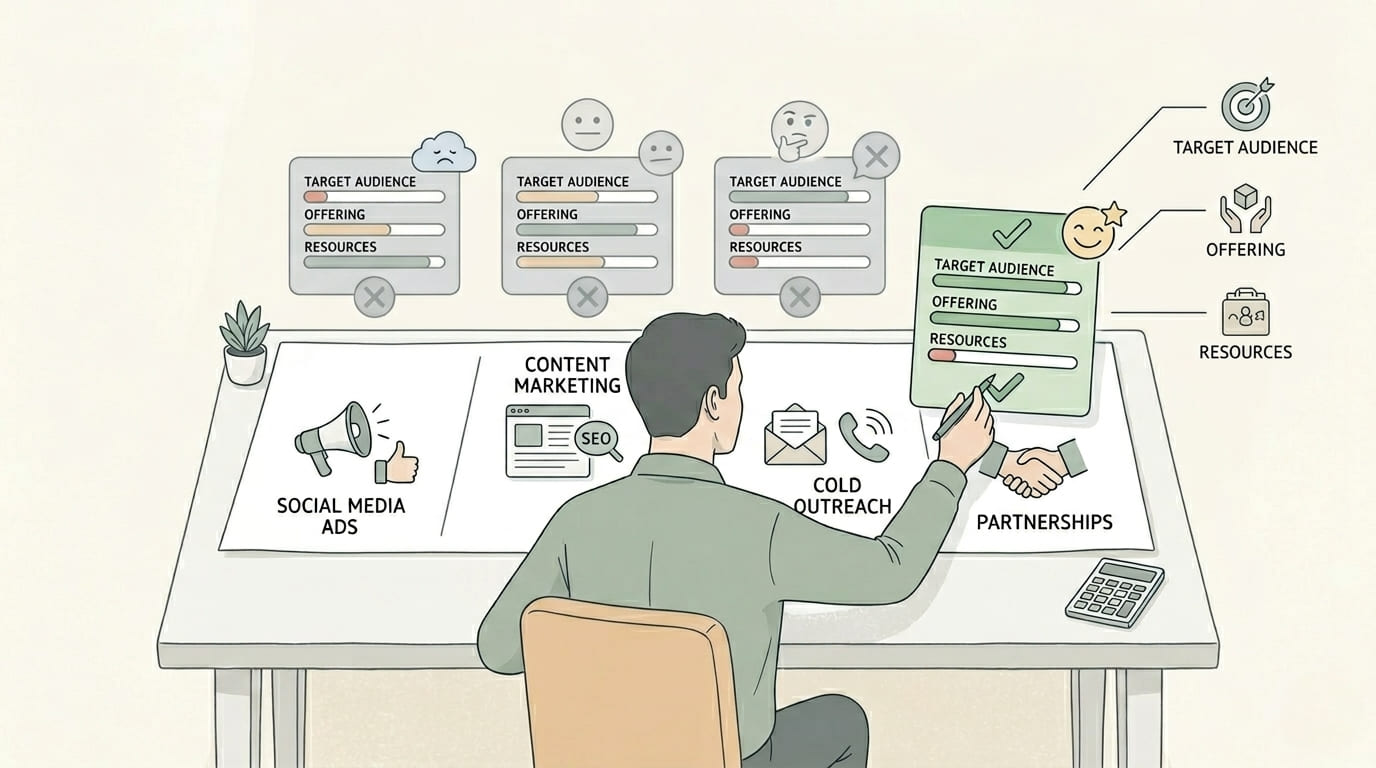
Customer acquisition is not about finding the one channel that is universally best. It is about choosing a channel that matches how your customers notice the problem, evaluate risk, trust a solution, and decide to buy. It also has to fit your price, margins, sales process, team capacity, and patience.
This piece breaks down how to choose a customer acquisition channel, compare the main options, design a useful channel test, and avoid confusing attention with real demand.
Acquisition Channels Are Part of the Business Model
A customer acquisition channel is the route through which a potential customer discovers the business, develops enough trust to evaluate it, and takes a commercial next step.
That route affects more than marketing.
A high-value consulting engagement can justify personal outreach, several conversations, and a custom proposal. A low-priced self-service product usually cannot support that level of effort for every customer. An urgent problem may perform well in search because customers already know what to look for. A problem that customers tolerate for months may need education, referrals, or direct conversations before it becomes visible.
The same channel can therefore be sensible for one business and wasteful for another.
Paid search may work well for a product where buyers actively search with strong intent. It may fail for a new category where nobody knows what to type. LinkedIn content may help a consultant whose buyers trust expertise and point of view. It may do little for a local service business whose customers mostly search when the need appears.
A channel is not only a place to publish or advertise. It is a fit between customer behavior and business economics.
Start With How Customers Already Move
Before choosing channels, look at what customers already do when the problem appears.
A founder selling software to agencies might assume LinkedIn is the right channel because agency owners spend time there. That may be true. But the relevant question is more specific: when an agency realizes client projects are starting with missing information, where does that problem surface?
It might appear in delivery meetings. It might come up after a client complains. It might be discussed privately with an operations consultant. It might not become a search query at all until someone names the problem clearly.
A different business has a different pattern. If a company suddenly needs payroll support in a new country, the buyer may search immediately, ask their accountant, or contact a provider recommended by another founder. The urgency is clearer. The search language is more predictable. The decision path is shorter.
Useful acquisition work begins with these movements:
- How does the customer notice the problem?
- What are they already using instead?
- Who do they ask for advice?
- Do they search for solutions or wait for someone to explain the issue?
- How much trust is needed before they take the next step?
Those questions are not abstract research. They decide whether the first serious channel should be search, outreach, partnerships, content, referrals, communities, paid acquisition, or something product-led.
The VynaroAI guide on defining your ideal customer profile is useful here because acquisition becomes much easier once the customer type, situation, problem severity, buying ability, and reachability are clear.
The Main Types of Acquisition Channels
Most businesses do not need to evaluate every possible channel with equal intensity. They do need to understand the major patterns.
Search-driven channels
Search-driven channels capture demand that already exists.
This includes organic search, search ads, directories, marketplaces, review sites, and comparison pages. Google describes Search campaigns as a way to show ads to people actively searching online for relevant products and services, which is the core advantage of the channel.
Search works best when customers recognize the problem and use language that can be targeted.
A founder looking for "startup idea validation tool" is easier to reach through search than a founder who only feels vaguely uncertain about whether an idea is worth pursuing. A business searching for "client portal software for accountants" is already much closer to a buying situation than a business that has not yet connected client friction to a specific software category.
Search is weaker when the category is new, the problem is poorly understood, or the customer uses language that differs from the company's internal terminology.
It can also create false confidence. Traffic does not equal demand. A broad article may bring visitors who are curious but not likely to buy. A high-intent keyword may be so competitive that the economics do not work.
Search is attractive because intent is visible. It still needs qualification.
Relationship-driven channels
Some purchases depend heavily on trust.
Referrals, partnerships, communities, events, advisors, agencies, consultants, and professional networks all work by transferring credibility from one relationship to another.
This matters when the purchase feels risky, expensive, operationally sensitive, or hard to evaluate from a website alone.
A company choosing a payroll provider, a security consultant, or an operations advisor may not simply pick the first result in search. They may ask someone they trust. They may want proof that the provider understands their situation. They may prefer a recommendation from a partner already close to the business.
Relationship channels are often slower to build than paid campaigns or outreach lists. The advantage is quality. A good introduction can create more trust than several weeks of cold exposure.
The limitation is control. Referrals and partnerships do not become repeatable just because people like the business. They need a clear reason to recommend the offer, a defined best-fit customer, and an easy way to make the introduction.
Outbound channels
Outbound includes cold email, direct messages, calls, founder-led sales, and account-based outreach.
It is most useful when the target customers can be identified and the potential value supports personal effort. It is also useful early because it creates direct feedback.
A good outbound test can reveal which segments respond, which problems sound urgent, which messages feel generic, and which objections appear before pricing even comes up.
The channel is often blamed when the real problem is relevance.
A message sent to the wrong list with a vague proposition will struggle almost anywhere. A smaller list of well-matched prospects with a clear reason for contact can produce useful conversations even before the company has a mature marketing engine.
The question is not whether outbound feels scalable from day one. Early on, it may be valuable precisely because it is manual. Paul Graham's essay "Do Things That Don't Scale" argues that founders often need to recruit users manually at the beginning rather than waiting for them to arrive.
That does not mean manual acquisition should remain the whole strategy forever. It can be the quickest way to learn what a later strategy needs to say.
Audience-driven channels
Content, newsletters, social media, podcasts, webinars, speaking, and community participation build access over time.
These channels work best when customers need education, trust expertise, or benefit from seeing the company's thinking before they buy.
They are also easy to misunderstand.
An audience is not the same as an acquisition system. A founder can build followers who enjoy the content but never buy. A newsletter can grow while attracting people outside the best-fit customer segment. A post can perform well because it is relatable, not because it moves the right buyer toward a decision.
Audience-driven channels need a commercial path.
A reader may move to a diagnostic tool, a case study, a product trial, a consultation, a waitlist, or a structured offer. Without that path, the business may create attention without learning whether the attention belongs to future customers.
This does not mean every piece of content should sell. It means the channel should eventually connect to a business decision.
Product-driven channels
Some products can acquire customers through usage.
Free tools, templates, calculators, assessments, trials, integrations, shareable outputs, and collaborative workflows can all introduce value before a sale.
This works when the customer can experience something useful without a long explanation.
A market-sizing calculator can reveal how uncertain a founder's assumptions are. A free assessment can show where a business has positioning gaps. A collaborative tool can spread when users invite teammates or clients.
Product-driven acquisition is appealing because the product itself creates part of the demand. It is not automatically cheap. Free users still require product development, infrastructure, onboarding, and support.
The channel works when free usage produces qualified learning, qualified leads, referrals, or conversion. If it mainly attracts people who enjoy free tools but never face the paid problem, the signal is weaker than it looks.
Match the Channel to Your Business Reality
After the main options are clear, the decision becomes more practical.
A channel has to fit the way the business can actually win customers.
The first factor is access. Can you reach the right customer with reasonable accuracy? A directory of 2,000 suitable companies creates a different opportunity from a vague audience of "small businesses." A channel is stronger when it gives you access to the people, companies, search terms, communities, or partners that match your ideal customer profile.
The second factor is economics. A channel that requires several calls may make sense for a $20,000 service. It probably does not make sense for a $19 monthly product unless the process later becomes self-serve or referral-driven.
The third factor is trust. Some offers can be evaluated quickly. Others need case studies, expert content, demonstrations, referrals, security evidence, or direct conversations. The channel either needs to create that trust or connect naturally to something that does.
Time also matters.
Outbound can produce conversations within days. Paid search can test existing demand relatively quickly. Partnerships may require weeks or months before they produce qualified introductions. SEO and audience building may take longer, but can become valuable once they compound.
A slow channel is not a bad channel. It is a bad primary learning channel if the business needs answers immediately.
Finally, execution has to be honest. Choosing video because it is popular makes little sense if nobody can produce useful video consistently. Choosing partnerships without anyone owning the relationships creates the same problem. Choosing SEO without the patience and quality required to compete often leads to abandoned half-work.
The right channel usually sits at the intersection of customer behavior, economics, trust, timing, and the team's ability to execute.
Choose One Primary Channel and One Supporting Channel
Small teams often interpret omnichannel too literally.
B2B buyers may move across many touchpoints. McKinsey's 2024 B2B Pulse research describes continued investment in omnichannel sales, and its related B2B go-to-market analysis notes that customers often use many interaction channels during buying journeys.
That does not mean an early business should operate everywhere.
A more practical structure is to choose one primary channel and one supporting channel.
The primary channel creates discovery, qualified conversations, leads, or trials.
The supporting channel helps customers trust, evaluate, or convert.
A consultant might use targeted outreach as the primary channel and a small set of case studies as the supporting channel.
A SaaS company might use SEO as the primary channel and a free diagnostic tool as the supporting channel.
An agency might build partner referrals as the primary channel and support them with a focused website that explains its specialization clearly.
This approach keeps the business focused without pretending customers only need one touchpoint.
The Bullseye Framework from Gabriel Weinberg and Justin Mares' Traction uses a similar idea: consider many possible channels, test the most promising ones, then focus on what shows traction. The useful lesson is not that every business must follow the framework exactly. It is that channel choice should come from evidence, not habit.
Design a Channel Test That Can Teach You Something
A weak test often looks like this:
A founder publishes a few posts, sends twenty emails, spends a small amount on ads, and updates the website. Nothing obvious happens. The channel is labeled as ineffective.
The problem is that the test never had enough shape.
A useful channel test answers a specific question.
For example:
Can we generate qualified conversations with operations leads at small agencies by using a direct outreach message focused on lost project context between sales and delivery?
That question is narrow enough to test.
It defines the customer, the channel, the message, and the desired signal. If it works, the founder learns something useful. If it fails, the founder can diagnose the failure more clearly.
- Was the list wrong?
- Was the problem not urgent?
- Was the message too broad?
- Was the role not the right buyer?
- Did people respond but fail to convert?
- Did they understand the problem but prefer the existing workaround?
A good test needs four things.
First, a defined segment. Do not test agencies, consultants, ecommerce brands, and local service businesses at the same time and call the result one experiment.
Second, a clear next step. That might be a reply, booked call, trial signup, quote request, assessment completion, or demo request. The next step should match the level of trust the channel has created.
Third, enough activity to reveal a pattern. One article, five messages, or a tiny ad test may only prove that the test was small. The right volume depends on the channel, but it has to be enough to separate signal from luck.
Fourth, a realistic time window. A two-week outbound test may teach something. A two-week SEO test usually cannot. Partnerships may need time to identify the right partner, create a reason to collaborate, and see whether referrals actually happen.
The goal is not to over-engineer every experiment. The goal is to stop confusing scattered activity with learning.
Measure More Than Traffic
Traffic is easy to count. It is also easy to overvalue.
A channel should be judged by how it moves the business toward customers who can buy, succeed, and remain worth serving.
Start with access. Did the channel reach the intended audience?
Then look for intent. Did suitable people respond, search further, request information, use the tool, book a call, or take the next step?
After that, examine economics. What did it cost in money and time? How long did conversion take? How much sales effort was needed? Could that effort be repeated without depending entirely on the founder?
Finally, look at customer quality.
Did the customers understand the offer? Did they activate? Did they stay? Did they need unusual support? Did they match the business you want to build?
A channel that produces fewer but better customers may be more valuable than one that produces many low-intent leads. This is especially true for small teams, where poor-fit customers consume support, sales, and product attention quickly.
A useful acquisition metric should move closer to commercial value as the test matures.
Early on, qualified conversations may matter more than revenue. Later, customer acquisition cost, payback period, retention, and expansion become more important. The mistake is treating top-of-funnel numbers as proof before the full path is understood.
Diagnose the Problem Before Abandoning the Channel
A disappointing result does not automatically mean the channel is wrong.
Sometimes the target is wrong. Sometimes the message is too vague. Sometimes the offer is weak. Sometimes the timing is bad. Sometimes the channel reaches users but not buyers.
Diagnose where the path broke.
If suitable customers never saw the offer, the access problem comes first.
If they saw it but did not respond, revisit the problem, message, timing, or audience.
If they responded but did not buy, examine the offer, proof, qualification, pricing, and sales process.
If they bought but did not stay, acquisition may not be the main problem. The product, onboarding, delivery, or original promise may need attention.
There are cases where the channel should be deprioritized.
That is more likely when suitable customers are difficult to isolate, acquisition effort exceeds customer value, the channel cannot create the trust the purchase requires, or the team cannot execute it consistently.
But abandoning a channel should come after diagnosis, not frustration.
Your First Channel May Be Manual
Early acquisition often looks unimpressive from the outside.
A founder writes personal messages. They ask for introductions. They join narrow communities. They onboard customers by hand. They have calls that do not scale. They learn from five serious prospects instead of five thousand anonymous visitors.
That can feel inefficient. It can also be the work that makes later channels effective.
Manual acquisition reveals language. It shows which problems customers describe without prompting. It exposes objections. It reveals the current workaround. It shows what proof buyers need. It helps the founder understand which segments respond with urgency and which only offer polite interest.
Those insights can later improve search content, landing pages, paid campaigns, partnerships, onboarding, and product-led flows.
A scalable channel built on weak customer understanding is still weak. A manual channel that produces real learning can become the foundation for something more repeatable.
The first channel does not need to be the final channel. It needs to create evidence the business can use.
Scale Only When You Know Why It Works
A channel is not ready to scale just because it produced a few customers.
Before increasing budget or hiring around it, the business should understand the conditions that made it work.
- Which customer segment responded?
- What trigger made them care now?
- Which message earned the next step?
- What proof reduced hesitation?
- How long did conversion take?
- What did acquisition cost in money and effort?
- Did the resulting customers stay valuable?
- Which parts of the process can be repeated by someone other than the founder?
The answers do not need to be perfect. They need to be clear enough that scaling does not simply amplify confusion.
Every channel also has constraints.
Search demand may be limited. Outbound lists can become exhausted. Advertising costs can rise. Communities may resist repeated promotion. Partnerships may depend on a small number of relationships. Content may attract learners rather than buyers.
A working channel should be monitored, not worshipped.
Choose for Fit, Then Earn the Right to Expand
Customer acquisition gets easier when the business stops asking which channel is generally best and starts asking which channel fits the way its customers buy.
Search needs recognizable demand. Outbound needs a specific reason to contact someone. Content needs a useful point of view and a commercial path. Partnerships need mutual value. Product-led acquisition needs an experience that creates value before the sale.
Start with the customer's buying situation. Compare it with the economics and capabilities of the business. Choose one primary channel and one supporting channel. Run a test that is specific enough to teach you something.
Then keep the test honest.
More channels do not create a stronger acquisition system. A clear understanding of why one channel works does.
When you are ready to turn customer and market assumptions into a more focused growth plan, VynaroAI's structured business tools can help you work through your market, customer profile, positioning, and acquisition decisions.