

How to Write a Value Proposition Customers Actually Understand
Some value propositions fail quietly.
They look professional. They sound positive. They pass internal review. Everyone agrees the sentence is clear enough to publish.
Then a customer reads it and still does not know why they should care.
The problem is usually not grammar. It is not even the length of the sentence. The problem is that the value proposition stays too far away from the customer's real situation. It promises to save time, improve productivity, unlock growth, or simplify work, but never explains which problem is being solved, what changes in practice, or why the offer is a better option than the way the customer handles the issue today.
Customers do not need a sentence that sounds impressive. They need a sentence that helps them understand.
That does not require clever wording. It requires clearer decisions before the wording starts.
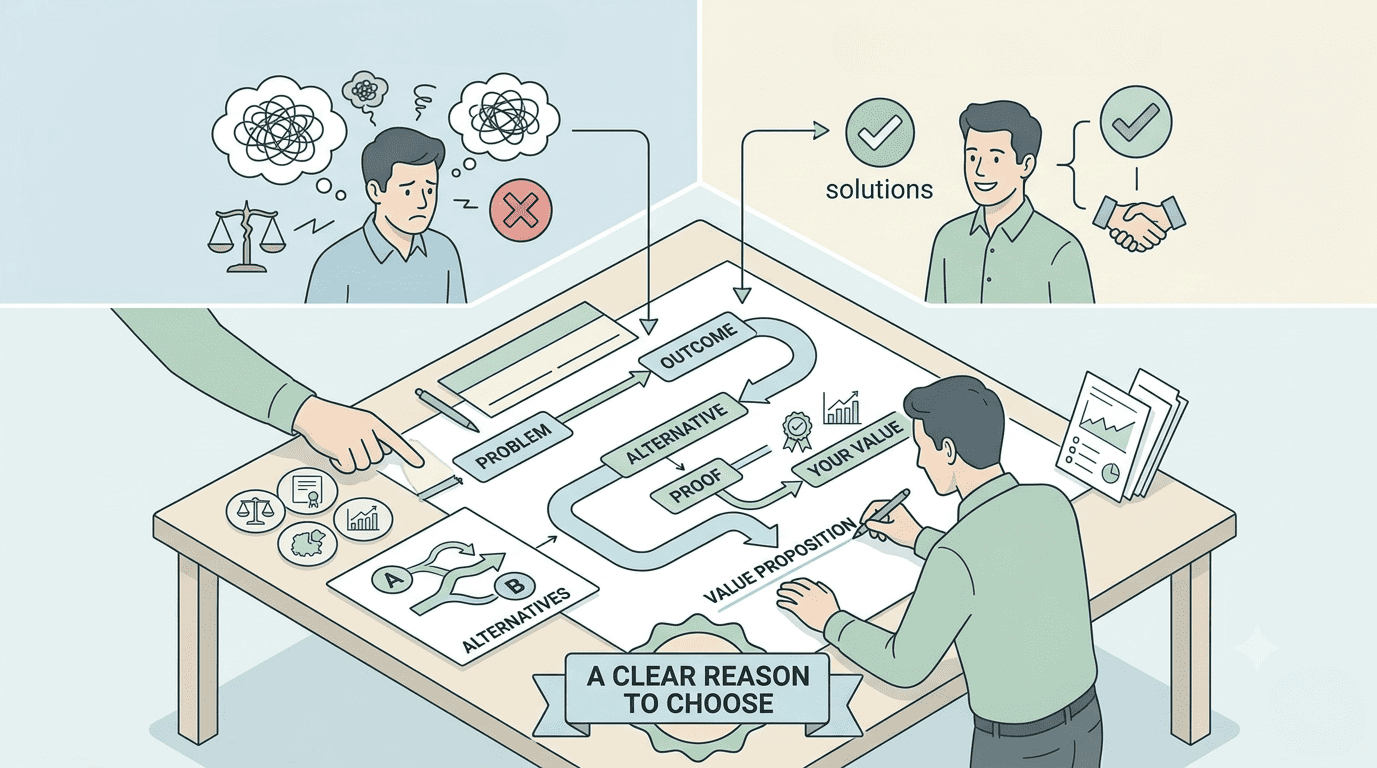
This piece breaks down how to write a value proposition customers can actually understand, using customer evidence, problem clarity, alternatives, outcomes, and proof instead of vague benefit language.
What a Value Proposition Is Supposed to Do
A value proposition explains the value a customer can expect from an offer.
That sounds simple, but many value propositions are asked to do too much. They try to describe the product, impress the market, sound differentiated, cover every use case, and reassure every possible buyer at the same time.
The result is usually broad and forgettable.
The real job is more practical. A customer should quickly understand:
- Who is this for?
- What problem or situation does it address?
- What does it help me do better, faster, more reliably, or with less risk?
- Why should I keep reading?
- Why might this be a better fit than my current alternative?
The Value Proposition Canvas from Strategyzer is useful because it connects customer jobs, pains, and gains with the ways an offer relieves pain and creates value. That connection matters. The sentence becomes weak when it starts with what the company wants to say instead of what the customer is trying to get done.
For an early business, this is not just a marketing exercise. The value proposition affects the homepage, sales calls, product priorities, onboarding, pitch decks, and acquisition channels.
If the value is vague, everything downstream becomes harder.
Value Proposition, Positioning, and Messaging Are Related
These terms often overlap, but they do different jobs.
Positioning defines the market context. It decides who the offer is for, what alternatives customers compare it with, which difference matters, and why the business is credible.
The value proposition states the value the customer can expect in that context.
Messaging turns that value into the language used across the website, sales material, ads, emails, and product pages.
A tagline may express part of the value proposition, but it is not the value proposition itself.
For example:
Work smarter with AI.
That could be a tagline. It does not give enough context to work as a value proposition.
A clearer version would carry more of the strategic logic:
VynaroAI helps early founders turn scattered business ideas, customer assumptions, and market research into structured decisions about validation, positioning, and pitch.
The sentence is longer, but it gives the customer more useful information. It names the audience, the starting point, the work being done, and the business outcome.
It may still need to be refined for a homepage. The important part is that it contains real value rather than a general promise.
When the positioning behind the sentence is unclear, the value proposition usually becomes vague as well. The VynaroAI guide on positioning a business when competitors look similar explains how to build that foundation before turning it into messaging.
Start With the Customer Situation
Weak value propositions often begin with the product.
They describe what the tool does, what features it includes, or what category it belongs to. That information can be useful later, but it is rarely the best starting point.
Customers usually care because of a situation.
A founder is preparing for investor conversations and realizes the pitch still changes every time someone asks what the business does. An agency is growing past founder-led delivery and starts losing client context between sales and execution. A consultant is spending hours turning internal work into client-ready reports. A small team is comparing several tools and cannot see which one fits its actual workflow.
The situation gives the value proposition something concrete to attach to.
The Jobs to Be Done perspective is helpful here because it looks at the progress customers are trying to make in a specific circumstance. Clayton Christensen and his coauthors explain this in HBR's article on knowing your customers' jobs to be done. For value proposition work, the lesson is practical: the customer's situation often explains the purchase better than a broad demographic label.
Instead of starting with:
We help small businesses grow.
Ask:
Which small businesses? In what situation? What are they trying to change? What makes the current way frustrating or risky?
The clearer the moment, the easier it becomes to explain the value.
Name the Problem in Customer Language
A customer should not have to translate your language into their reality.
This is where many value propositions lose clarity.
Companies say:
We improve operational efficiency.
Customers say:
We keep losing project details after the sales call.
Companies say:
We provide actionable insights.
Customers say:
I do not know which customer segment to focus on first.
Companies say:
We streamline reporting workflows.
Customers say:
I spend Friday afternoon copying data into a client update that still looks messy.
The customer version is usually more useful.
It is specific. It carries context. It shows where the pain appears. It gives the business stronger language for the website, sales calls, and product explanations.
This does not mean every value proposition has to sound informal. The final wording can still be professional. But the underlying problem should be grounded in the way customers actually describe it.
A helpful test is simple:
Could the customer say, "Yes, that is exactly what happens"?
If not, the problem may still be too abstract.
The VynaroAI guide on defining your ideal customer profile is useful before this step because the strongest customer language usually appears when the segment and situation are specific enough.
Connect the Problem to a Practical Change
Naming the pain is only the first part.
The customer also needs to understand what changes because the offer exists.
This is where features have to be translated carefully.
A feature says:
Automated market research.
A practical change says:
Compare customer segments and market signals without starting from a blank research document.
A feature says:
AI-powered pitch deck writer.
A practical change says:
Turn your business idea, market context, and positioning into a clearer investor narrative.
A feature says:
Customer avatar builder.
A practical change says:
Define the customer who is most likely to feel the problem, buy the offer, and succeed with it.
The practical change is the bridge between the product and the customer's outcome.
It tells the customer what becomes easier, clearer, faster, safer, more consistent, or more believable.
Not every change needs to be dramatic. Sometimes the strongest value is about removing friction from a small but recurring problem. A consultant who saves three hours every week on reporting may not describe that as "transformational." They may still pay for it because the value is clear.
Bain's B2B Elements of Value is useful here because it shows that business buyers value more than functional performance. They may also value reduced risk, confidence, simplification, reputation, or easier collaboration. In B2B, the value proposition often needs to address both the company's result and the buyer's personal risk.
The clearer the practical change, the less work the customer has to do.
Show the Alternative
Customers rarely compare your offer with nothing.
They compare it with a competitor, a spreadsheet, a consultant, a template, an internal process, a tool they already use, or doing nothing for now.
That alternative shapes the value proposition.
If the customer is currently using a spreadsheet, the value may be structure, consistency, and less manual work.
If they are using a large platform, the value may be focus, speed, and less implementation burden.
If they are hiring consultants, the value may be repeatability and lower cost.
If they are doing nothing, the value proposition has to make the problem feel worth addressing in the first place.
A statement that ignores the alternative often feels incomplete.
For example:
Project handover software for agencies.
This explains the category, but not the reason to choose it.
A clearer version might be:
Help small agencies transfer signed scope, client expectations, and delivery risks without relying on scattered proposal notes or another complex project management setup.
Now the comparison is visible. The customer can see what the offer replaces or improves.
That is especially useful in crowded markets. If several companies promise similar outcomes, the alternative helps make the difference more concrete.
Add Proof Where the Customer Would Doubt You
Every value proposition makes a promise. The customer immediately decides whether that promise seems believable.
That decision may happen quietly.
If the promise is "save time," the customer may wonder how much time and where.
If the promise is "better decisions," they may wonder what information the system uses.
If the promise is "simpler workflows," they may wonder whether the product is actually simple or just hides complexity behind a nicer interface.
If the promise is "built for agencies," they may wonder whether the company understands agency operations or is simply using a popular niche.
Proof does not always belong inside the value proposition sentence itself. Too much proof can make the sentence heavy. But proof should appear close to the claim.
A homepage might support the value proposition with:
- a short product screenshot or workflow
- a customer example
- a specific use case
- a measurable result
- a method or process
- a comparison against the old workflow
- a testimonial from a relevant customer
- a clear explanation of how the product creates the outcome
The type of proof should match the claim.
A speed claim needs time evidence or process clarity.
A specialization claim needs relevant focus or customer examples.
A simplicity claim needs visible reduction of work.
A strategic claim needs a method that explains how recommendations become decisions.
Without proof, the value proposition may attract attention but struggle during evaluation.
A Practical Process for Writing the Value Proposition
You do not need to begin with the perfect sentence.
It is usually better to build the logic first and then reduce it.
1. Write the customer situation
Start with a plain description of the customer and the moment that makes the offer relevant.
For example:
Small agencies with separate sales and delivery teams often lose client context after a proposal is signed.
This is not copy yet. It is the context.
2. Write the problem and consequence
Add what goes wrong and why it matters.
Client expectations, delivery risks, and commitments from the sales process get spread across proposals, notes, calls, and project management tasks. Delivery teams then start projects with missing context.
Now the value has a place to attach.
3. Write the current alternative
Describe how the customer handles it today.
They rely on kickoff meetings, manual notes, shared documents, and the project management tool they already use.
This keeps the value proposition grounded in the customer's real world.
4. Write the practical change
Explain what the offer helps them do differently.
The product creates a structured handover workflow that captures the required information before delivery begins.
This connects the capability to a change in behavior.
5. Write the outcome
State the outcome in terms the customer cares about.
Delivery teams can start client projects with fewer clarification calls, fewer missed commitments, and a clearer view of what was agreed during sales.
At this stage, the value proposition may be too long. That is fine.
A rough version might look like this:
For small agencies that lose client context between sales and delivery, our handover workflow captures scope, expectations, risks, and commitments before delivery begins, so teams can start projects with fewer clarification calls and fewer missed details.
That sentence can be shortened and shaped later. The important thing is that it contains real value.
Turn the Long Version Into a Clear Sentence
Once the logic is clear, reduce the sentence without losing the substance.
A strong version often includes four parts:
- the customer
- the problem or situation
- the practical change
- the outcome or reason to care
For example:
A client project handover system for small agencies that need to transfer scope, expectations, and delivery risks before work begins.
This is concise. It is also specific.
Another version could be more outcome-led:
Help agency delivery teams start client projects with the context, commitments, and risks that were agreed during sales.
This version sounds more like homepage messaging.
Both are valid. They emphasize different parts of the value.
The right version depends on where it appears. A homepage hero may need to be more direct and customer-facing. An internal positioning brief may need more context. A product page may need a clearer category. A sales deck may need more proof.
The sentence does not have to appear in exactly the same form everywhere. But the underlying idea should stay consistent.
Examples: Weak to Clearer
A few examples make the difference easier to see.
Example 1: Business research tool
Weak:
AI-powered insights to help founders make better decisions.
Clearer:
Help early founders turn business ideas, market research, and customer assumptions into clearer decisions about validation, positioning, and pitch.
The clearer version names the customer, the inputs, and the decisions being supported.
Example 2: Reporting tool
Weak:
Save time with automated reporting.
Clearer:
Help consultants create client-ready monthly reports without copying data across spreadsheets, dashboards, and slide decks.
The clearer version makes the work visible.
Example 3: Team operations software
Weak:
A powerful platform for growing teams.
Clearer:
Help small operations teams document recurring workflows before growth turns informal processes into repeated mistakes.
The clearer version explains why the tool matters now.
Example 4: Strategy consultant
Weak:
Strategic guidance for ambitious businesses.
Clearer:
Help founder-led service businesses choose a clearer customer segment, sharpen their offer, and turn scattered growth efforts into a focused plan.
The clearer version shows the customer and the decisions being improved.
These examples are not better because they are more creative. They are better because they reduce the work the customer has to do.
Common Value Proposition Mistakes
Many value propositions fail in familiar ways.
Starting with the company instead of the customer
A company may write:
We are an innovative platform using advanced AI to transform business planning.
The customer has to translate that into their own problem.
A customer-led version starts closer to the situation:
Turn early business assumptions into clearer decisions about customers, market, positioning, and pitch.
This gives the reader something to recognize.
Making the value too broad
Broad value feels safe because it includes more people. It also makes the message easier to ignore.
Grow faster.
Save time.
Make better decisions.
These can be real outcomes, but they need context. Save time doing what? Make better decisions about which part of the business? Grow by reaching whom?
Specificity creates usefulness.
Confusing features with value
Features matter, but customers do not always know why they should care.
If the sentence lists capabilities without explaining the change they create, the customer has to finish the argument.
That is risky. Many will not.
Promising too much
The value should be attractive without becoming inflated.
If the product helps founders structure early business thinking, say that. Do not claim it guarantees startup success. If the service improves reporting consistency, say that. Do not claim it will transform the entire company.
Customers trust specific promises more than dramatic ones.
Forgetting the buyer's risk
In B2B, the buyer often has to justify the decision to someone else.
A founder may worry about wasting money. An operations lead may worry about adding another tool the team will not use. A manager may worry about choosing a vendor that creates internal friction.
If the value proposition only describes upside and ignores risk, it may feel incomplete.
Sometimes the strongest value is not a bigger result. It is a safer path to a result.
Test Whether Customers Understand It
A value proposition should be tested for clarity, not just preference.
Do not ask only whether people like the wording. Ask what they think it means.
Show the sentence to someone in the target segment and ask:
- What do you think this offer does?
- Who do you think it is for?
- What problem do you think it solves?
- What would you compare it with?
- What would you expect to see next?
- What would make you believe it?
The answers will reveal whether the sentence is carrying the intended meaning.
If people understand the product but not the customer, the segment may be missing.
If they understand the customer but not the outcome, the value may be too vague.
If they understand the outcome but not the difference, the alternative may need to be clearer.
If they understand everything but do not care, the problem may not be important enough or the customer may be wrong.
The goal is not to find the cleverest wording. The goal is to reduce confusion.
Use the Value Proposition Across the Business
Clear value should influence more than the homepage.
On the website, it helps structure the hero section, supporting copy, proof points, product explanation, and calls to action.
In sales, it helps qualify prospects and explain why the offer fits their situation.
In product, it helps decide which features strengthen the core value and which features distract from it.
In content, it helps choose topics connected to the customer's real problem rather than broad industry commentary.
In pitch materials, it helps investors or partners understand the business without forcing them to assemble the logic themselves.
Consistency does not mean repeating the same sentence everywhere. It means the same underlying idea appears clearly in each context.
A sales call may use more diagnostic language.
A homepage may use more direct outcome language.
A pitch deck may connect the value proposition to market size, customer pain, and differentiation.
The wording can change. The logic should not.
When to Revisit Your Value Proposition
A value proposition should evolve when the evidence changes.
Revisit it when customers describe the problem differently from your website, when a narrower segment converts better, when a different use case produces stronger retention, when competitors change the comparison, or when sales calls repeatedly require the same clarification.
Do not rewrite it every time the sentence feels old.
A tired founder is not always a sign of tired messaging. Sometimes the team has simply looked at the same sentence too long.
Look for market evidence instead.
- Are the right customers understanding it?
- Are they taking the next step?
- Are sales conversations becoming clearer?
- Are poor-fit leads decreasing?
- Are customers repeating the value back in similar language?
Those signals matter more than whether the line feels fresh internally.
Clear Value Comes Before Clever Copy
A value proposition is not there to impress the customer with language.
It is there to make the value easier to understand.
Start with the customer's situation. Name the problem in words they recognize. Show what changes because the offer exists. Make the alternative visible. Support the promise with proof. Then reduce the logic into a sentence that can guide the website, sales process, product decisions, and pitch.
The best value propositions are rarely the most decorative. They are the ones that help the right customer see, quickly, why this offer belongs in their decision.
For founders turning customer research and positioning into a clearer value proposition, VynaroAI can help structure the work across customer profiles, pain points, USP, positioning, and pitch.