

How to Conduct Customer Interviews That Reveal Real Buying Intent
Customer interviews can make an idea feel safer than it really is.
A founder speaks with ten people. Most of them understand the idea. Several say the problem sounds familiar. A few say they would probably try the product when it launches.
On paper, that looks like validation.
But when the product is ready, the same people do not sign up, do not reply, do not introduce a buyer, and do not spend money. The interviews created encouragement, but they did not reveal buying intent.
This happens because many customer interviews stay too close to the idea and too far away from the customer's real behavior. They ask people to imagine a future purchase instead of examining what they are already doing, what the problem already costs them, and what would make change worth the effort.
A better interview does not try to convince the customer. It tries to understand the buying situation before the pitch begins.
This piece breaks down how to conduct customer interviews that reveal real buying intent, including who to interview, what to ask, what signals to look for, and how to turn conversations into better decisions about the idea, customer, offer, and next test.
Customer Interviews Are Not Just Feedback Calls
A customer interview is not a chance to collect compliments.
It is a way to learn how a specific person experiences a problem, what they already do about it, which alternatives they trust, how much the issue matters, and what would need to happen before they changed behavior.
That sounds obvious. In practice, interviews often drift into pitch mode.
The founder explains the idea too early. The customer reacts to the explanation. The conversation becomes about opinions: whether the concept sounds useful, whether the design looks good, whether the person can imagine using it, and which features might be interesting.
Those answers are not worthless. They can help refine communication. But they are weak evidence of demand.
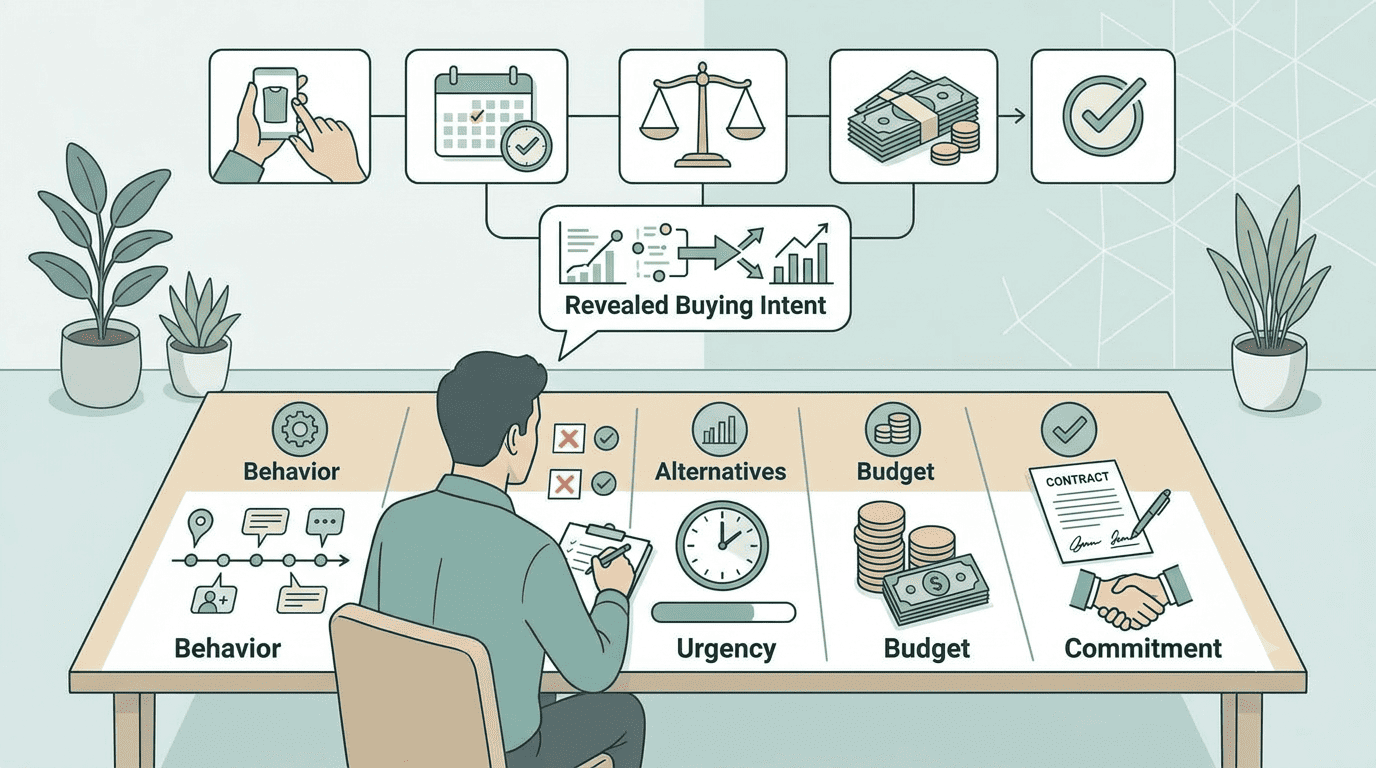
Buying intent usually appears in a different place. It appears in the customer's current workaround, recent frustration, urgency, internal pressure, budget reality, decision process, and willingness to take a next step.
That is why the best interviews often feel less like product feedback and more like careful listening.
The customer should do most of the talking. The founder's job is to understand the situation clearly enough to decide whether the problem is real, specific, painful, reachable, and commercially meaningful.
What Buying Intent Actually Means
Buying intent is not the same as interest.
Interest can be polite. It can be hypothetical. It can come from curiosity, friendliness, or the desire to help.
Buying intent is stronger because it connects the problem to action.
A customer shows buying intent when they have already tried to solve the problem, are actively looking for a better way, have a clear reason to act soon, understand the cost of doing nothing, control or influence the budget, and are willing to take a meaningful next step.
That does not always mean immediate payment.
For an early product, buying intent might show up as a paid pilot, a pre-order, a serious demo request, a referral to the actual buyer, access to a workflow, a follow-up meeting with other stakeholders, or permission to test the solution against a real use case.
The important part is friction.
When someone has to give time, money, access, internal credibility, or attention, the signal becomes more useful. A person who says "sounds interesting" has given very little. A person who says "send me something I can show our operations lead" has given more. A person who pays for a pilot has given much more.
Customer interviews should help you understand where on that spectrum the conversation actually sits.
Interview the People Closest to the Problem
The quality of the interview depends heavily on who is being interviewed.
A conversation with someone outside the problem can still produce useful perspective, but it should not be treated as validation. Friends, other founders, advisors, and general business contacts may be supportive without being buyers.
The better starting point is the person who experiences the problem directly or has responsibility for solving it.
If you are building a reporting tool for consultants, speak with consultants who actually create recurring client reports. If you are building handover software for agencies, speak with people involved in sales-to-delivery transitions. If you are building a tool for early founders preparing investor materials, speak with founders who are actively shaping a pitch, not people who vaguely like startups.
The VynaroAI guide on defining your ideal customer profile is useful here because interviews become much stronger when the segment, situation, problem severity, buying ability, and reachability are already more specific.
You do not need the perfect ICP before interviewing. Interviews often help shape it. But you do need enough focus to avoid mixing signals from people with completely different problems.
Five interviews with well-matched people can be more useful than twenty conversations with a vague audience.
Prepare Around Recent Behavior
Good interviews begin before the call.
Instead of preparing a pitch, prepare the assumptions you need to test.
For example:
- This customer has the problem often enough to care.
- The problem creates a cost in time, money, risk, or missed opportunity.
- The current workaround is frustrating.
- The customer has tried to solve it before.
- The buyer and user may not be the same person.
- The value of solving it could justify the price or effort.
- The customer is reachable through a realistic channel.
Those assumptions should shape the conversation.
The most useful questions are usually about recent behavior, not future imagination. This is one of the core lessons behind The Mom Test: ask about the customer's life and what has already happened, rather than asking people to judge your idea directly.
Instead of asking:
Would you use a tool that automates this?
Ask:
When was the last time this problem happened?
Instead of:
Would this be useful?
Ask:
What did you do the last time you had to solve it?
Instead of:
Would you pay for this?
Ask:
Have you paid for anything to solve this already?
Recent behavior keeps the conversation grounded. It also makes vague enthusiasm harder to hide behind.
Start With the Situation, Not the Solution
The first part of the interview should help you understand the customer's context.
Do not rush into the product idea.
Start with the situation where the problem appears. Ask about the customer's role, workflow, recent trigger, current process, and what has changed that makes the issue more noticeable.
For example:
Can you walk me through the last time this happened?
That question often reveals more than a direct opinion question.
A founder might discover that the problem appears only once a quarter, not every week. Or that the person complaining about the problem does not control the budget. Or that the current workaround is annoying but accepted. Or that the customer only cares when a client is involved, not when the task is internal.
The Jobs to Be Done perspective is helpful here because it focuses on the progress people are trying to make in a specific circumstance. HBR's article on knowing your customers' jobs to be done is useful because it shifts attention away from broad demographics and toward the situation that creates the need for change.
A customer is rarely buying because they match a persona. They are buying because something about their current situation has become costly, risky, frustrating, or strategically important.
The interview should uncover that moment.
Ask About the Current Alternative
Every customer already has an alternative.
They may use a competitor, a spreadsheet, an internal process, a freelancer, an employee, a template, a meeting, a habit, or nothing at all.
That alternative matters because it defines the real comparison.
A founder building software may believe the main competitor is another software company. The interview may reveal that the real competitor is a shared Google Sheet and a weekly operations call. A consultant may think they are competing with other consultants, but the customer may be comparing the engagement with hiring internally or postponing the decision.
Ask questions such as:
- What are you using today?
- How did you choose that approach?
- What works well enough about it?
- What breaks or becomes frustrating?
- What would make switching worth the effort?
- Who would need to approve a change?
These questions reveal whether the problem has enough weight to overcome inertia.
Many early businesses underestimate the strength of "good enough." A current workaround may be messy, but familiar. A spreadsheet may be inefficient, but free. A manual process may be frustrating, but politically safe.
Buying intent becomes more believable when the customer can clearly explain why the current alternative is no longer enough.
Listen for Urgency
A painful problem is more valuable when it has a reason to be solved soon.
Urgency can come from different places.
A deadline is approaching. A team is growing. A client complained. Costs increased. A compliance requirement appeared. A manual process started breaking. A founder is preparing for fundraising. A customer segment became more important. A tool that used to work no longer fits the workflow.
Without urgency, the customer may agree that the problem exists but keep postponing action.
That is not a bad interview outcome. It is useful information.
Ask:
- Why is this coming up now?
- What happens if nothing changes?
- How long has this been a problem?
- What made you start looking for a better approach?
- Is anyone internally pushing to solve it?
If the customer says the problem has existed for years and nothing has changed, the founder should be careful. The pain may be real but not strong enough to drive behavior.
If the customer says the problem became urgent last month because a major client almost left, the signal is different.
The timing tells you whether the idea is solving a background annoyance or an active buying problem.
Understand the Buyer, Budget, and Decision Process
A customer interview that ignores the buying process can mislead you.
The person feeling the pain may not be the person who pays. The person who pays may not understand the day-to-day frustration. A team may want the solution but have no budget. A founder may love the idea but need a partner's approval. An operations lead may have authority for a small tool but not for a platform-level purchase.
Buying intent depends on these realities.
Ask carefully, without turning the conversation into an interrogation:
- How are tools or services like this usually approved?
- Who would need to be involved?
- Is there already budget for solving this kind of problem?
- Have you bought something similar before?
- What would make this easy or hard to approve?
- What would create concern internally?
These questions are not only for enterprise sales. Even a small self-service product has a buying process. The process may be one person with a credit card, but that person still weighs effort, trust, price, urgency, and perceived risk.
For higher-priced offers, the buying process can be the difference between interest and revenue.
A user who says "I would love this" may still be unable to buy. A buyer who says "this would reduce a known cost" may be much closer to real demand.
Avoid Questions That Teach the Customer What to Say
Some questions make customers more positive than they actually are.
- Would you use this?
- Do you like this idea?
- Would this save you time?
- Would your team benefit from this?
- Is this something you would pay for?
These questions are tempting because they sound direct. The problem is that they invite the customer to be helpful, optimistic, or polite. They also reveal what the founder wants to hear.
A better interview uses neutral questions.
Instead of asking whether the product would save time, ask how long the current process takes.
Instead of asking whether the problem is important, ask what else is competing for attention.
Instead of asking whether they would pay, ask what they have already paid for and how similar purchases are approved.
Instead of asking what features they want, ask what they tried the last time the problem appeared.
Nielsen Norman Group's User Interviews 101 makes a related point in a UX context: interviews are useful for learning about users' experiences, needs, and values. For business validation, that means the founder should create space for the customer's reality instead of steering the conversation toward agreement.
The less the customer feels guided toward the "right" answer, the more valuable the answer becomes.
Pay Attention to the Customer's Language
Customer interviews are not only useful for validation. They also reveal language.
The words customers use often become better marketing language than the words founders start with.
A founder may describe the problem as "inefficient stakeholder alignment." The customer may say, "Every project starts with someone asking what was promised during sales."
The second version is clearer because it sounds like the actual experience.
Listen for phrases that appear repeatedly:
- "We keep having to…"
- "The annoying part is…"
- "This always breaks when…"
- "I usually just…"
- "The real issue is…"
- "I would need to know…"
- "My concern would be…"
These phrases show how the customer frames the pain, the workaround, the trigger, and the hesitation.
That language can later improve the value proposition, landing page, outreach message, sales script, and product onboarding.
But do not copy one customer's wording too quickly. Look for patterns across several interviews. Strong messaging usually comes from repeated language, not one memorable phrase.
Test Commitment Without Forcing the Sale
At some point, the interview should move toward a real next step.
That does not mean pressuring someone. It means checking whether the interest survives a small amount of friction.
Depending on the offer, the next step might be:
- joining a qualified waitlist
- booking a follow-up conversation
- introducing the actual buyer
- sharing a workflow or document
- agreeing to a pilot
- paying for early access
- reviewing a proposal
- testing a prototype with real data
- committing to a deadline for the next decision
The key is to choose a step that matches the stage of the business and the seriousness of the problem.
A person who gives detailed feedback but avoids every next step may still be useful as a research participant. They may not be a buyer.
A person who brings a colleague into the next call, shares internal context, or asks what it would take to start is showing a stronger signal.
This is where many founders receive the most important answer of the interview. The conversation may sound positive for thirty minutes. Then the next step reveals whether the problem matters enough to continue.
Turn Interviews Into Evidence
Interviews should not disappear into scattered notes.
After each conversation, summarize the evidence in a consistent format.
A useful interview summary might include:
- customer type and role
- situation where the problem appears
- current workaround
- cost of the problem
- urgency or trigger
- alternatives considered
- buying authority or influence
- budget reality
- objections or risks
- exact customer language
- meaningful next step taken or avoided
The last point matters.
Do not record only what the customer said. Record what they did.
Did they agree to another call? Did they introduce someone? Did they ask for pricing? Did they share a process? Did they commit to a pilot? Did they disappear after saying they were interested?
Behavior should weigh more than enthusiasm.
After several interviews, look for patterns. Similar customers with similar problems, similar workarounds, similar urgency, and similar next steps create a stronger signal.
Mixed signals are not a failure. They may tell you the segment is too broad, the problem is not frequent enough, the buyer is different from the user, or the offer needs to be narrower.
The VynaroAI article on why founders validate the wrong signals goes deeper into the difference between encouragement and evidence.
A Simple Customer Interview Structure
A good interview does not need to be complicated.
A simple structure is often enough.
Start with context:
Tell me about your role and how this area works today.
Move into the recent situation:
When was the last time this problem came up?
Explore the current process:
What did you do to handle it?
Understand the cost:
What made that frustrating, slow, expensive, risky, or difficult?
Find the alternative:
What tools, people, processes, or workarounds are involved today?
Check urgency:
Why does this matter now, if it does?
Understand buying reality:
How would something like this normally be evaluated or approved?
Listen for concerns:
What would make you hesitate to change the current approach?
Only after that should you introduce the idea, prototype, or offer if it makes sense.
When you do, keep the explanation short. Then return to questions:
- What feels relevant here?
- What does not match your situation?
- What would need to be true for this to be worth trying?
- What would be the natural next step if this did solve the problem?
This structure keeps the interview grounded in reality before the customer reacts to the solution.
Common Interview Mistakes
The first mistake is interviewing too broadly.
If every conversation comes from a different type of customer, the founder may collect many interesting stories but no useful pattern.
The second mistake is pitching too early.
Once the customer understands what the founder wants to build, they may start reacting to the idea instead of describing the problem honestly.
The third mistake is accepting compliments as evidence.
A customer can admire the idea and still have no reason to buy it.
The fourth mistake is ignoring the current workaround.
The workaround reveals the customer's real tolerance for pain. If the workaround is cheap, familiar, and politically safe, the new solution has to be meaningfully better.
The fifth mistake is avoiding budget and buying questions.
Founders sometimes skip these questions because they feel uncomfortable. But buying intent cannot be understood without them.
The sixth mistake is failing to ask for a next step.
Without a next step, the founder may leave with interest but no signal of commitment.
The seventh mistake is treating one conversation as proof.
One strong interview can point in the right direction. It should not carry the whole decision alone.
When the Interview Says No
A good interview may reveal that the idea is weaker than expected.
That can be uncomfortable, but it is useful.
Maybe the problem exists but is not urgent. Maybe the customer has no budget. Maybe the buyer is different from the user. Maybe the current workaround is good enough. Maybe the segment is wrong. Maybe the pain only appears in rare cases. Maybe the customer likes the concept but would not change behavior.
That information is not a waste.
It helps the founder avoid building on a polite misunderstanding.
The next decision may be to narrow the customer segment, change the offer, test a different problem, adjust pricing, speak with another buyer, or stop pursuing the idea.
Customer interviews do not exist to protect the original plan. They exist to make the next decision more honest.
Use Interviews to Shape the Next Test
An interview is rarely the final proof.
It should lead to the next useful test.
If several customers describe the same problem and current workaround, create a landing page that uses their language and tests whether similar people take action.
If customers show urgency but hesitate on trust, build a proof point, case example, pilot structure, or demo that reduces perceived risk.
If the buyer and user are different, run interviews with both sides before building the sales motion.
If people care about the problem but will not take a next step, revisit the offer or the segment.
If customers repeatedly ask about price, workflow, integration, implementation, or approval, those concerns should shape the next validation step.
The goal is not to keep interviewing forever. At some point, conversation needs to turn into behavior.
But better interviews make those behavior tests sharper. They help you choose the right customer, write a clearer value proposition, build a more relevant offer, and avoid testing a generic version of the idea.
Better Interviews Reveal What Polite Feedback Hides
Customer interviews are valuable when they move beyond opinion.
The strongest conversations reveal what the customer is doing now, what the current approach costs, why the problem matters, what alternatives are trusted, who controls the decision, what risk blocks action, and whether the person is willing to take a meaningful next step.
That is where buying intent becomes visible.
Not in the compliment. Not in the imagined future. Not in the sentence "I would definitely try this."
Buying intent appears when the customer's behavior, urgency, buying reality, and commitment all point in the same direction.
A good interview does not guarantee that the idea will work. It gives the founder a clearer view of what has to be true for the idea to deserve the next step.
For founders turning customer conversations into better evidence, VynaroAI can help structure idea validation, pain point research, customer profiles, market assumptions, and next steps in one connected workspace.