

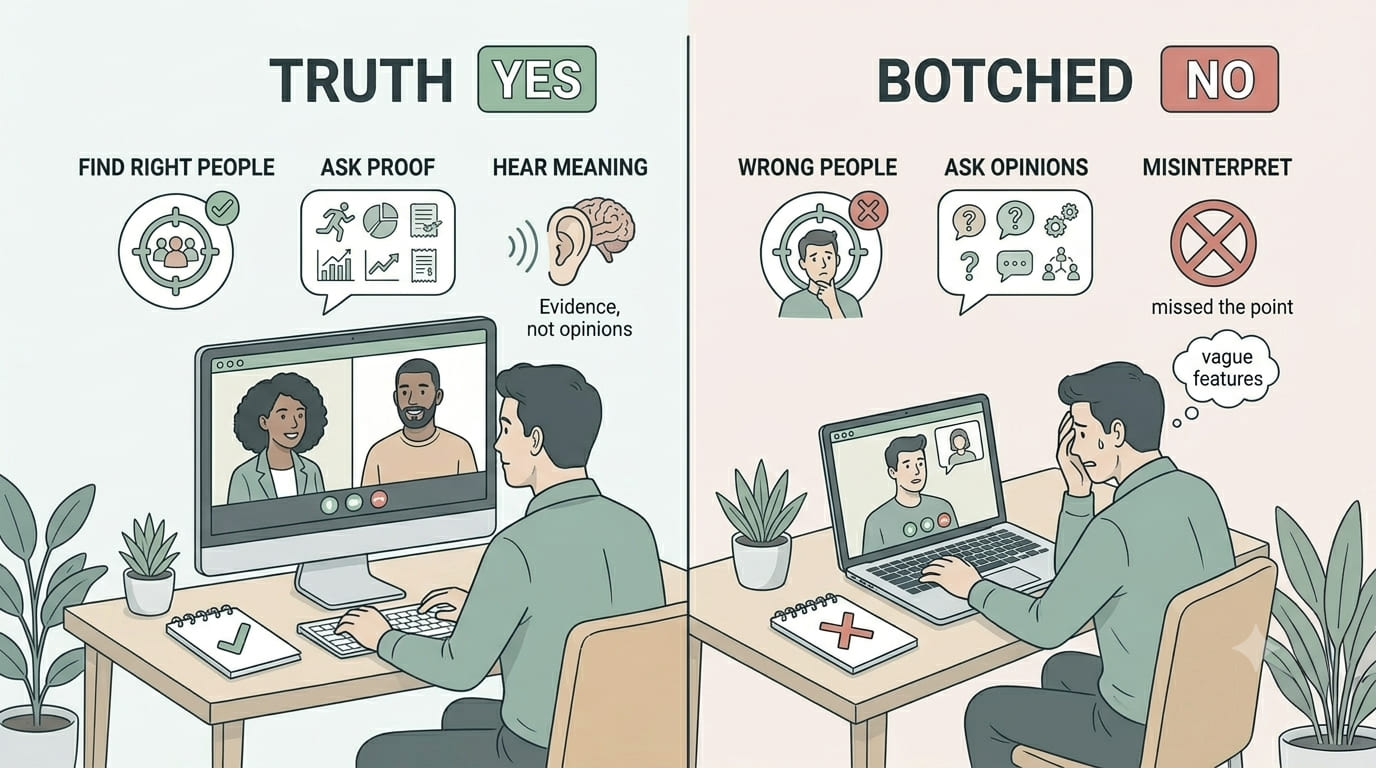
How to Run Customer Interviews That Tell You the Truth
Customer interviews have a strange property: they are the most universally recommended validation method, and one of the easiest to do in a way that quietly produces garbage.
The garbage doesn't look like garbage. It looks like ten pleasant conversations, a notebook full of encouraging quotes, and a founder who is now more confident and less informed than before. The people were friendly. The questions invited friendliness. Nothing in the process ever created a moment where the truth could show up.
The good news is that honest interviews are not harder than flattering ones. They just follow different rules.
This piece breaks down who to interview, how to find them, how many conversations you actually need, what to ask, and how to interpret answers without fooling yourself.
Why Interviews Produce False Positives by Default
People are polite. When you describe an idea you clearly care about, most listeners will find something nice to say — not because they intend to mislead you, but because agreeing costs them nothing and disappointing a stranger feels bad. We've written before about why this kind of validation goes wrong; interviews are where the failure usually starts.
Three mechanics do most of the damage.
You pitch too early. The moment you explain your idea, the conversation stops being research and becomes a reaction to you. Everything the person says afterward is filtered through not wanting to hurt your feelings.
You ask about the future. "Would you use this?" and "Would you pay for this?" invite imagination, and imagination is generous. People are poor predictors of their own future behavior and excellent narrators of their past behavior. This is the central argument of The Mom Test: ask about the person's life and what they have actually done, not about your idea and what they might do.
You interview people who want you to succeed. Friends, family, and your existing network will round every answer up. Useful interviews mostly happen with strangers who face the problem and owe you nothing.
None of this means interviews are weak evidence. It means the evidence quality is decided by the setup, before the first question is asked.
Who to Talk To — and How to Find Them
The right interview subjects are people who live inside the problem today. Not people who might someday, not people adjacent to it — people who dealt with it this month.
Getting specific helps enormously. "Founders" is not an interviewable group. "Solo founders who launched a product in the last year and handle their own marketing" is — you know where they gather and what to ask them.
Practical ways to reach them:
Communities where the problem is discussed. Subreddits, Discord and Slack groups, niche forums, Facebook groups. Don't post "can I interview you about my startup." Participate first, then message people who described the exact struggle you're researching: "You mentioned X in that thread — I'm researching how people handle it. Could I ask you about your experience for 20 minutes? Not selling anything."
Direct outreach. LinkedIn or email to people whose role matches your target profile. Short message, specific reason you picked them, clear time ask, explicit statement that nothing is being sold. Response rates are low; that's normal. You need a handful of yeses, not a campaign.
People one step away. Ask each interviewee at the end: "Do you know one or two other people who deal with this?" Warm referrals convert far better than cold messages, and they keep you inside the real segment.
People who almost bought. If you already have a product, the most underrated interviews are with people who signed up and never activated, or churned quickly. They know exactly why they left, and they'll usually tell you.
On incentives: a small thank-you (a gift card, early access) is fine and sometimes necessary. Just be aware that paid participants are slightly more inclined to be agreeable — which is one more reason your questions must not reward agreement.
How Many Interviews Are Enough?
There is no magic number, and anyone who gives you one without context is guessing. The honest framing comes from qualitative research: you interview until saturation — the point where additional conversations stop teaching you new things.
Nielsen Norman Group's guidance on interview sample sizes is useful here. For exploratory research, five interviews are often too few, and the group cites research by Abbie Griffin and John Hauser estimating that around 20–30 interviews were needed to uncover roughly 90% of customer needs in the category they studied. That is a ceiling for thoroughness, not an entry requirement.
For a founder's practical purposes, a workable rhythm looks like this: run five interviews, then stop and review. If the five conversations pointed in five directions, your segment is probably too broad — narrow it before continuing. If clear patterns are forming, run five to ten more and watch whether the patterns hold. When you can predict most of what the next person will say before they say it, you've hit saturation for this round.
The number matters less than the independence. Three strangers who describe the same workaround unprompted are worth more than fifteen acquaintances who agree with your summary of the problem.
Preparing: The Interview Guide
Improvised interviews drift into chats. The fix is a lightweight interview guide — not a script you read, but a short document that keeps the conversation aimed at your research goal.
NN/g's article on writing interview guides describes the approach well: define the research questions first (what you need to learn), then write open-ended interview questions that could surface those answers, roughly ordered, with easy warm-up questions at the start. In a semistructured interview you're free to skip questions, reorder them, and chase interesting statements — the guide exists so that freedom doesn't turn into wandering.
Your research goal at validation stage is usually some version of: Is this problem real for this segment? How painful is it? What are they doing about it today? What would switching have to beat?
Everything in the guide should serve those questions. Anything that serves your ego — questions engineered to produce enthusiasm — gets cut.
One more preparation rule: interview one person at a time. Groups produce social consensus, and social consensus is exactly the noise you're trying to remove.
Running the Interview: Questions That Produce Evidence
The core technique is simple to state and takes practice to hold: keep the person in their past, in specifics.
Open with their world, not your idea. "Tell me about the last time you had to [do the task]" is the workhorse question. Last time, not usually — "usually" produces an idealized summary; "last time" produces a story with real details, real tools, real frustration.
Follow the story downward. "What did you do then?" "How long did that take?" "What happened after?" "Who else was involved?" The follow-ups are where the material lives. Y Combinator's guidance on talking to users makes the same point: you're extracting facts about their life, and the specifics are the value.
Ask about money and time already spent. "Have you paid for anything to solve this?" "Have you tried building your own fix?" Past spending is the strongest signal an interview can produce.
Let silence work. After an answer, wait three seconds before your next question. People fill silence with the thing they almost didn't say — and that thing is often the most honest sentence of the interview.
Hold your pitch until the end, if at all. Once the research questions are covered, you can describe what you're building and watch the reaction. Just weigh that reaction correctly: it's a courtesy response, not evidence. The evidence was everything before it.
A few translations from common bad questions to their honest versions:
- "Would you use a tool that does X?" → "What do you currently use for X? Walk me through it."
- "Is this a big problem for you?" → "When did this last cost you real time or money? What happened?"
- "Would you pay $19 a month for this?" → "What do you currently spend — in tools, people, or hours — dealing with this?"
- "Do you like this idea?" → (nothing — this question has no honest version)
After the Interviews: Hearing What Was Actually Said
Interpretation is where the second wave of self-deception arrives, so it needs its own discipline.
Write notes immediately, and separate facts from compliments. "This is really cool" is a compliment; it goes in one pile and carries no weight. "I export everything to a spreadsheet every Friday and it takes two hours" is a fact; it goes in the evidence pile. If a session recording or transcript is available, quotes beat memory — memory is biased toward what you hoped to hear.
Look for patterns across people, not highlights within one. A single vivid interview is a story. The same pain, the same workaround, or the same trigger appearing independently across several strangers is a finding. Tally how many people said a thing unprompted, not how enthusiastically one person said it.
Track disconfirming evidence deliberately. Somewhere in your notes there should be a section titled "reasons this idea might be wrong," filled from the interviews. If that section is empty after ten conversations, the interviews were run to confirm, not to learn.
Connect what you heard to what you were looking for. Frequency, cost, and who feels it most — the same criteria that decide whether a pain point is worth building on — are the frame for reading interview results. Pain that people describe vividly but have never spent a minute or a euro addressing is a warning, not a green light.
And then remember what interviews can and cannot do. They tell you whether the problem is real, how people experience it, and what language they use. They do not tell you whether people will pay — only a real commitment test does that. Interviews are the beginning of evidence, not the verdict.
The Skill Is Restraint
Almost everything that separates a useful customer interview from a flattering one comes down to restraint: not pitching, not leading, not filling silences, not rounding answers up, not stopping at the first encouraging pattern.
That restraint feels unnatural because you want the idea to be good. Every founder does. But the interview is one of the few places where being wrong is cheap — a conversation costs twenty minutes, while building on a false positive costs months.
Run the conversations so the truth has room to show up. Then have the discipline to act on what it says.
If you're turning interview notes into decisions, VynaroAI can help you structure what you learned — pain points, customer profiles, and what to validate next — in one connected workspace. Start free at VynaroAI.