

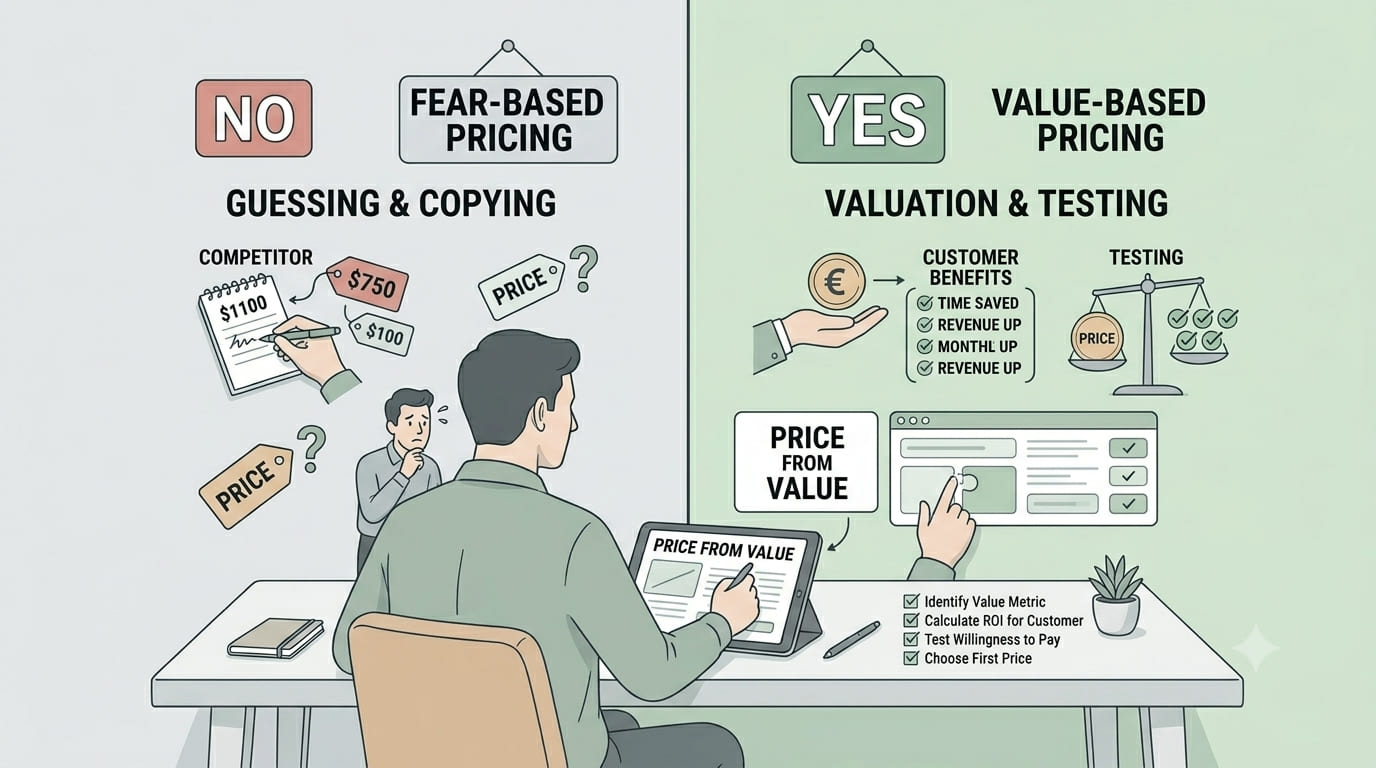
How to Price Your First Product Without Guessing
Here is how most first products get priced: the founder looks at two or three competitors, picks a number slightly below them, rounds it to something ending in 9, and moves on to problems that feel more urgent.
The whole decision takes an afternoon. Then it sits untouched for a year.
That would be fine if price were a detail. It isn't. In a classic analysis published in Harvard Business Review, McKinsey's Michael Marn and Robert Rosiello found that across the large companies they studied, a 1% improvement in price — with volume held steady — raised operating profit by an average of 11.1%, more leverage than an equivalent improvement in variable costs, volume, or fixed costs. The exact number will differ for a small software business, but the direction of the finding holds at every size: price is one of the highest-leverage numbers in the company, and it usually gets the least deliberate attention.
This piece breaks down the three anchors every price hangs on, how to figure out what your product is worth to a customer, how to choose what you charge for, and how to set a first number you can defend — and later raise.
Why First Prices Are Almost Always Too Low
Underpricing is the default failure mode, and it has more to do with psychology than math.
A new founder has no brand, no track record, and a product with rough edges. Charging real money feels presumptuous. A low price feels safe — it lowers the stakes of every sales conversation and gives the founder a ready excuse when someone says no: at least it wasn't about the price.
There is also a strategic story founders tell themselves: price low now, win users, raise prices later. In Y Combinator's Startup Pricing 101, YC partner Kevin Hale lists pricing too low as the first of four mistakes startups make repeatedly — alongside underestimating costs, not understanding their own value, and focusing on the wrong customers. The talk also references Marc Andreessen's argument that this low-price growth story usually runs backwards: companies that charge more have more money for product and distribution, which is exactly what lets them grow.
A low price causes quieter damage too. It attracts the most price-sensitive customers, who tend to churn fastest and demand the most support. It signals low value — a serious buyer seeing a serious problem solved for very little money gets suspicious, not excited. And it leaves you no margin to spend on acquiring the next customer.
None of this means "always charge more" is a law. It means the burden of proof should sit on the low price, not the high one.
The Three Anchors: Cost, Competitors, Value
Every pricing approach hangs the number on one of three anchors, and choosing the anchor is the real decision.
Cost-plus. Add up what the product costs you, add a margin. This feels rigorous and is almost meaningless for software, where the marginal cost of serving one more customer is small. Your costs define your floor — the price below which the business bleeds — but they say nothing about what the product is worth. Do know your floor precisely, including the cost of acquiring a customer, not just serving one. Then stop using cost as the anchor.
Competitor-based. Look at what similar tools charge and position around them. Useful as context, dangerous as the anchor — it assumes competitors did the work, targets the same customer with the same value, and got it right. Copying a price means silently copying all three assumptions.
Value-based. Anchor the price on what the outcome is worth to the customer. Hale frames this as a thermometer with cost at the bottom, value at the top, and price sitting somewhere between: the gap between price and value is the customer's incentive to buy, and the gap between price and cost is your margin. For software, value-based is the right anchor essentially always — it is the only one of the three that gets stronger as your product gets better.
The practical question is how to find the top of that thermometer.
Work Out What It's Actually Worth
"Value" stays vague until you attach it to a specific customer and a specific outcome. The path there runs through questions you can genuinely answer.
What does the problem cost them today? Hours per week on a manual process, money spent on tools or freelancers, deals lost, decisions delayed. If you did honest discovery work, you already have this — it's the same evidence that told you the problem was worth solving.
What is your product's version of the outcome worth? Turn the cost of the problem into the value of the fix. A tool that saves a consultant four billable hours a month has a calculable worth to that consultant. A tool that helps a founder avoid building the wrong product for six months has a large, if fuzzier, worth.
Who feels that value most? The same product is worth different amounts to different segments. Pricing forces the same choice positioning does: you price for your best-fit customer — the one you defined when you worked out your ideal customer profile — not for the average of everyone who might sign up.
Hale offers a rule of thumb for this stage that is worth keeping visible: for a new product, aim for perceived value around ten times the price. A gap that wide makes the buying decision easy even for a skeptical customer facing an unproven tool. If you can't tell a credible ten-to-one story, that's not a signal to shave the price — it's a signal that either the value story or the target customer needs work.
Decide What You Charge For
Before the number comes the unit. What does the customer pay per — per month flat, per seat, per project, per usage?
Paddle's pricing strategy guide calls this the value metric, and argues that getting it right matters more than the price point itself. The logic: a flat fee charges your smallest customer and your largest customer the same, which means overcharging one and drastically undercharging the other. A value metric that scales with the value received lets small customers start cheap and grow into higher payments naturally — expansion revenue without a sales conversation.
The test for a good value metric is alignment: when the customer gets more value, the metric should go up. Seats align for collaboration tools, poorly for solo tools. Usage aligns when usage tracks value, badly when it makes customers afraid to use the product.
For a first product, resist over-engineering this. A simple structure — a low entry tier, a main tier where your target customer lands, a higher tier for heavy use — covers most early-stage cases. What matters is that the tier boundaries follow the value metric, so that the customers who get the most value are the ones paying the most. You can refine the model once real usage data exists; you can't refine data you don't have.
Set the First Number
With the anchor, the value story, and the metric decided, the number itself becomes a bounded choice instead of a dart throw.
Ask real prospects about price ranges, not single prices. A useful format comes from the price sensitivity meter developed in the 1970s by Dutch economist Peter van Westendorp, which asks four questions: at what price would this be so expensive you'd never buy it, at what price does it start feeling expensive, at what price is it a bargain, and at what price is it so cheap you'd doubt the quality. Even asked informally across ten or fifteen target customers, these questions map the acceptable range far better than "would you pay X?" — which, as with every hypothetical question, mostly measures politeness.
Use competitors as a sanity check, not a source. If your research puts you far above or below the market, you should be able to say why in one sentence. "We serve a narrower customer with a deeper solution" is a reason. "We were scared" is not.
Then commit and ship it. Your first price will be wrong in some direction — everyone's is. The goal is not a perfect number; it's a defensible number attached to a value story, live in front of real buyers, generating the only data that settles pricing questions: what people actually do at checkout.
One caution for this stage: be careful with launch discounts and lifetime deals. They generate a burst of revenue and a long tail of customers anchored to a price you'll never charge again. If you want launch momentum, a time-limited price with a clear end date does less long-term damage than a permanently devalued one.
Pricing Is a Process, Not a Decision
The founders who get pricing right are rarely the ones who nailed the first number. They're the ones who treated it as a living part of the business.
Hale's advice for this is concrete: practice raising prices — around 5% at a time — and keep going until the pushback becomes real, on the order of losing a fifth of your prospective customers. For a first-time founder that sounds aggressive. In practice, small increases applied to new customers, while existing customers keep their old price for a defined period, are one of the lowest-risk experiments a software business can run. New signups either keep converting — in which case you were underpriced — or they don't, and you've found an edge of the range at the cost of a few weeks of data.
Revisit the price whenever something material changes: the product gets meaningfully better, a new segment starts buying, retention proves the value story, or your acquisition costs shift. Price and acquisition are coupled — what you can afford to spend acquiring a customer is set by what that customer pays you — so a pricing review is never only a pricing review.
And keep one habit above all: never let the price drift below the value story. The moment you can no longer explain, in the customer's terms, why the product is worth several times what it costs, the problem isn't the number on the pricing page. It's that you've stopped measuring the value — and that is fixable, because you know how to do that work.
Price is the clearest statement a business makes about what it believes its work is worth. Make it a statement, not an apology.
If you're working out what your product is worth and to whom, VynaroAI's business tools can help you connect customer research, positioning, and value into decisions — including the pricing conversation you're about to have with yourself. Start at VynaroAI.